
ISA Certified Arborist Dayton Ohio: What the Credential Means for Your Trees
TL;DR: ISA Certified Arborist in Dayton Ohio
- An ISA certified arborist has passed the International Society of Arboriculture exam, proving tested knowledge of tree biology, pruning, diagnosis, and safe work practices.
- Certification matters most when the job involves risk: trees near homes, power lines, or structures, disease diagnosis, and structural pruning.
- A certified arborist is not the same as a licensed tree service. In Ohio, anyone can call themselves a tree service; the ISA credential is the independent proof of expertise.
- Always verify the credential on the ISA website and ask for insurance. Certification without insurance is a red flag.
- Tree Removal Dayton Ohio brings certified arborist oversight to removals, trimming, and hazard assessments across the Dayton area. Call (937) 969-1334.
When a tree company knocks on your door after a storm, or you get three quotes for a big removal, how do you know who actually understands trees? In Ohio, there is no state license required to call yourself a tree service. The closest thing to an independent quality check is ISA certification from the International Society of Arboriculture.
This guide explains what the credential means, when it matters, how to verify it, and what to ask before you hire anyone to work on your trees.
Want certified expertise on your tree problem? Call (937) 969-1334. Tree Removal Dayton Ohio puts trained, credentialed people on every job.
What Is an ISA Certified Arborist?
The International Society of Arboriculture is the global professional body for tree care. To earn its Certified Arborist credential, a candidate must document several years of hands-on experience, pass a comprehensive exam covering tree biology, soil science, pruning, diagnosis, safety, and equipment, and then keep up with continuing education every three years to stay certified.
The exam is not a formality. It tests whether the person understands how trees actually work: compartmentalization of decay, proper pruning cuts, species-specific responses, and how to read structural defects. That knowledge is the difference between a crew that removes a limb safely and a crew that butchers a tree or damages your house.
There are also specialty credentials worth knowing about:
- ISA Certified Arborist: the core credential for general tree care knowledge
- ISA Certified Arborist Utility Specialist: focused on trees near utility lines
- ISA Board Certified Master Arborist: the highest level, for complex diagnosis and consulting
- TRAQ (Tree Risk Assessment Qualified): specialized training in formal tree risk assessment
For most Dayton homeowners, the core Certified Arborist credential on the person planning or supervising your job is exactly what you need. If you are dealing with a questionable tree near your home, pair this guide with our hazard tree assessment guide to know what a proper evaluation covers.
When Certification Matters Most
For a simple brush pickup, certification is overkill. For anything involving judgment or risk, it is the whole point. Hire with the credential in mind when:
- The tree stands near your house, garage, fence, or a neighbor’s property
- The job involves climbing, rigging, or a crane, rather than simple felling in open space
- You need a diagnosis: is this tree sick, dying, or fine? What is actually wrong with it?
- You need structural pruning on a valuable shade tree you want to keep for decades
- Storm damage has left a partially failed tree and someone has to decide save versus remove
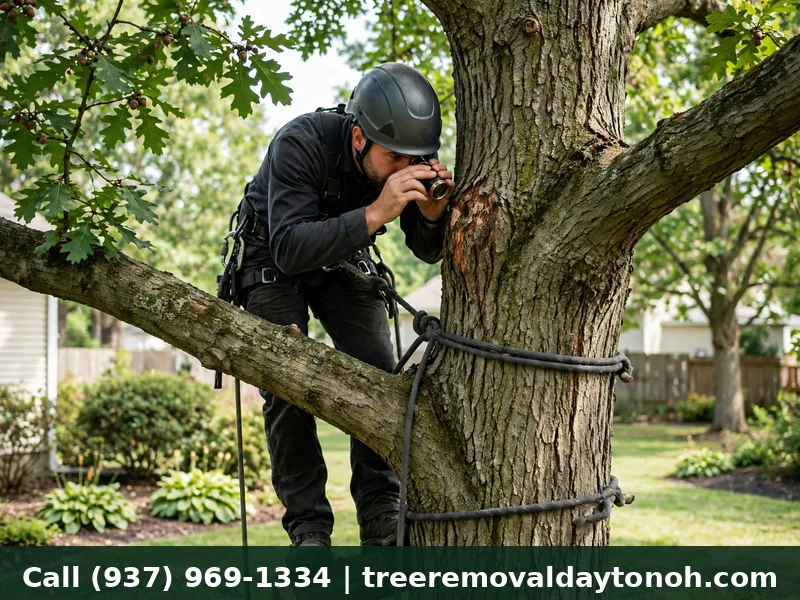
Dayton-specific examples come up constantly. Emerald ash borer has killed thousands of ash trees across the Miami Valley, and a certified arborist can tell you whether treatment is still viable or the tree is past saving. Our emerald ash borer guide covers that decision in detail. Storm-leaning trees after a wind event are another classic: anyone with a saw can cut it down, but only someone trained in tree mechanics should judge whether it can be saved.
Certified Arborist vs Regular Tree Service: An Honest Comparison
| Factor | ISA certified arborist oversight | Uncertified tree guy |
|---|---|---|
| Tree biology knowledge | Tested and continuing-ed maintained | Varies wildly; often learned on the job only |
| Diagnosis accuracy | Can distinguish treatable disease from decline | Often defaults to “it needs to come down” |
| Pruning quality | Proper cuts at the branch collar, species-aware | Topping and flush cuts are common |
| Safety training | ANSI standards, climbing and rigging best practice | Varies; this is where injuries and property damage happen |
| Insurance likelihood | Certified firms almost always carry full coverage | Check carefully; many operate uninsured |
| Price | Often higher, reflects real expertise | Often cheaper, but mistakes cost more |
The price row is where people hesitate. A certified crew may quote more than the guy with a pickup truck, but improper pruning, a dropped limb through a roof, or an unnecessary removal costs far more. If you are still evaluating companies, our guide on how to find a legitimate tree service in Dayton pairs well with this one.
Do not gamble on your biggest trees. Call (937) 969-1334 and get a certified eye on the problem before you decide anything.
How to Verify the Credential (Takes Two Minutes)
Anyone can print “certified arborist” on a flyer. Verification is easy and you should always do it:
- Ask for the arborist’s full name and ISA certification number
- Look it up on the ISA’s public credential verification page
- Confirm the certification is current, not expired or suspended
- Ask which credentialed person will actually be on your job, not just in the office
While you are at it, ask for proof of insurance: general liability and workers compensation. Then ask when their pruning recommendations follow ANSI A300 standards. A real professional answers these questions comfortably. Evasive answers are your signal to keep looking.
Important Considerations Before Hiring
- Ohio has no tree service license. There is no state board to complain to and no license to check. The ISA credential plus insurance is the closest thing to a verified standard, which is why it carries so much weight here.
- Certification does not replace insurance. A certified arborist who is uninsured is still a liability risk on your property. Demand both, every time.
- Beware the storm chasers. After Miami Valley wind events, out-of-town crews flood in. They rarely have certified staff, local references, or insurance you can verify. Local and verifiable beats fast and cheap.
- Get the diagnosis in writing. If an arborist says a tree is hazardous and must come down, ask for the reasoning in writing. A certified professional can explain the defect, the risk, and the alternatives clearly.
- Certification is about judgment, not just cutting. The highest-value thing an arborist does is tell you what NOT to do: the tree that does not need removal, the pruning that can wait, the treatment worth trying first.
- Pruning timing still matters. Even a certified arborist works within Ohio’s seasonal windows. See our Ohio pruning calendar so you know when your job should be scheduled.

FAQs: ISA Certified Arborists in Dayton
How far should a tree be from a house in Ohio?
Match the distance to the mature canopy spread: 30 to 40 feet for large shade trees, 15 to 20 feet for medium trees, and 8 to 10 feet for small ornamentals. In clay soil, add margin for wide root spread.
Can tree roots really damage a foundation?
Yes, indirectly. Roots exploit existing cracks and joints, widening them over years and channeling water toward the foundation. They also dehydrate clay soil in dry spells, causing uneven settling. In severe cases we see walls pushed inward on the tree side.
Will cutting the roots kill the tree?
It can. Removing more than about a quarter of a tree’s roots, or cutting large structural roots near the trunk, often destabilizes or slowly kills a mature tree. That is why root work near structures should be planned by an experienced arborist, not done with a chainsaw on a Saturday.
Does homeowners insurance cover tree root damage to a foundation?
Usually not. Gradual root damage is considered maintenance, not a sudden covered event. A tree that falls and damages the house in a storm is a different situation. See our guide on insurance claims for storm-damaged tree removal for what is typically covered.
Should I just trim the branches and leave the tree?
If the problem is purely canopy-related, pruning is often the right answer and costs far less than removal. If roots are damaging concrete, foundation, or sewer lines, pruning fixes nothing and the tree likely needs to come out.
Who removes a tree that is too close to a house in Dayton?
Call a professional tree service with experience in tight-access removals. Tree Removal Dayton Ohio handles crane-assisted and rigged removals where there is no room to fell a tree. Call (937) 969-1334 for a free on-site assessment.
Big decision about a big tree? Call (937) 969-1334 today. Get a certified arborist’s honest read on your tree’s health, your options, and what the job should actually cost before you commit to anything.


One Comment