
Huber Heights Storm Tree Damage: How We Respond After Miami Valley Wind Events
TL;DR: Huber Heights Storm Tree Damage at a Glance
- After a Miami Valley wind event, your first job is safety: stay clear of the tree, do not touch anything near power lines, and keep people and pets away from the damage zone.
- Document everything with photos before cleanup starts. Your photos are the backbone of any insurance claim.
- Trees with split trunks, uprooted root plates, or major lean cannot be saved. Trees with broken crowns but sound trunks often can.
- Our emergency response covers Huber Heights 24/7 after storms: hazard removal, safe limb takedown, and full debris cleanup.
- For storm-related insurance questions, see our guide on filing an insurance claim for storm-damaged tree removal.

Huber Heights sits right in the path of the wind events that roll across the Miami Valley, and after every one of them our phones light up. A tree through a fence in one neighborhood, a split silver maple hanging over a driveway in another, whole streets with branches stacked at the curb. Storm damage is stressful, but the order of operations is simple: make it safe, document it, then clean it up properly.
This guide walks through exactly what we do when Huber Heights homeowners call us after a storm, and what you should do in the first hours before we arrive.
Storm damage in Huber Heights? Call (937) 969-1334 now. Tree Removal Dayton Ohio responds 24/7 after Miami Valley wind events.
What to Do First When a Storm Damages Your Tree in Huber Heights
The first hour after the wind dies down is when most injuries happen, and almost all of them are preventable. Follow these steps in order.
- Stay away from the tree. A leaning tree, a hanging limb, or a partially uprooted trunk can shift without warning. Keep a distance of at least twice the tree’s height until a professional assesses it.
- Treat every downed line as live. If a tree or limb is touching a power line, do not approach it and do not try to move it. Call your utility company first, then call us. Our guide on tree removal near power lines explains why this step is non-negotiable.
- Photograph everything before you touch anything. Walk the property and take wide shots and close-ups of every damaged tree, every broken limb, and any damage to structures, fences, and vehicles. These photos are what your insurance adjuster will work from.
- Prevent further damage only if it is safe. A tarp over a punctured roof section is reasonable. Climbing a ladder to saw a hanging limb is not. Leave the tree work to insured crews.
- Call for emergency service. If a tree is on your house, blocking your driveway, or leaning in a way that could worsen, that is an emergency tree removal situation. We triage storm calls by hazard level, so tell us exactly what you see.
Trees We Cannot Save: When Removal Is the Only Safe Answer
Homeowners understandably ask whether their storm-damaged tree can be saved. Sometimes it can. Here is how we make the call, and you can use the same checklist while you wait for us.
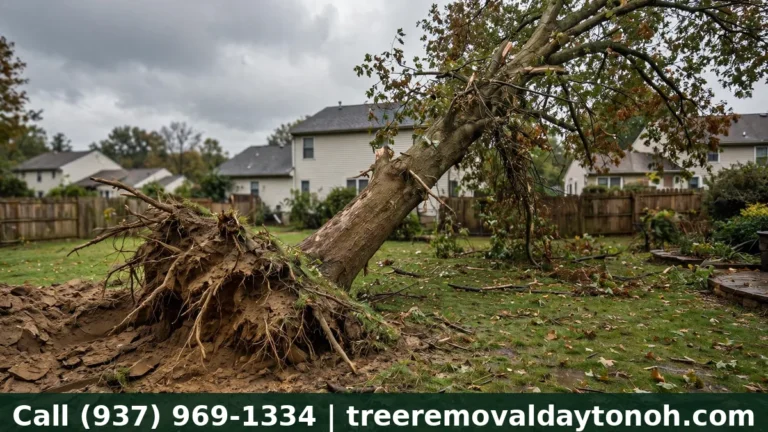
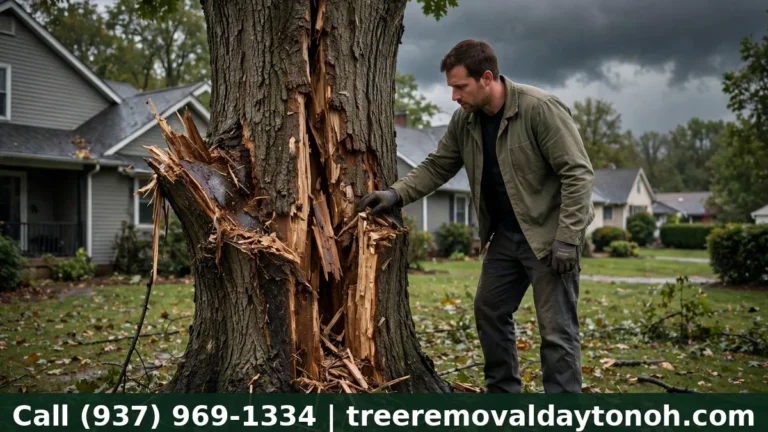
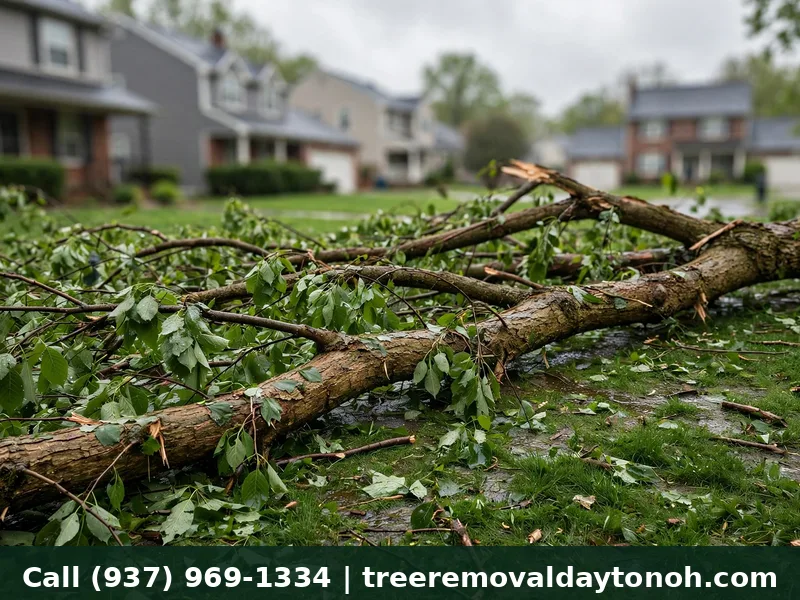
Trees we recommend removing after storm damage: trunks split through the middle or into major leaders, root plates lifted or soil heaved on one side (the tree is partially uprooted even if it is still standing), lean of more than about 15 degrees that appeared with the storm, and large trees with more than half the crown destroyed. These trees will not recover their structure, and they will fail again in the next wind event.
Trees we can usually save: broken or torn branches on an otherwise sound trunk, minor lean on a tree with an intact root plate, and crown damage limited to one side. Corrective pruning over one or two seasons restores these trees. Our dangerous tree signs guide covers the warning signs to watch for in the weeks after a storm, because some damage takes time to show.
Our Emergency Response Process After a Miami Valley Wind Event
When you call us after a storm, here is what happens, in order.
- Triage by phone. We ask what the tree hit, whether lines are involved, and whether anyone is in danger. True emergencies get priority dispatch.
- On-site hazard assessment. Our crew lead walks the damage, identifies what is stable and what could move, and sets up the work zone before any cutting starts.
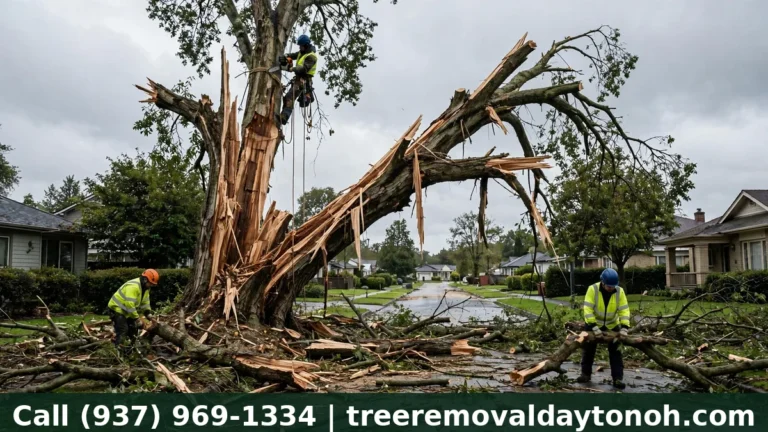
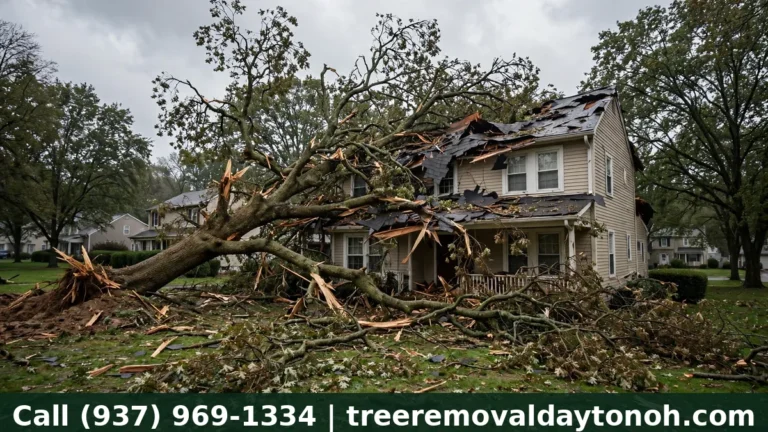
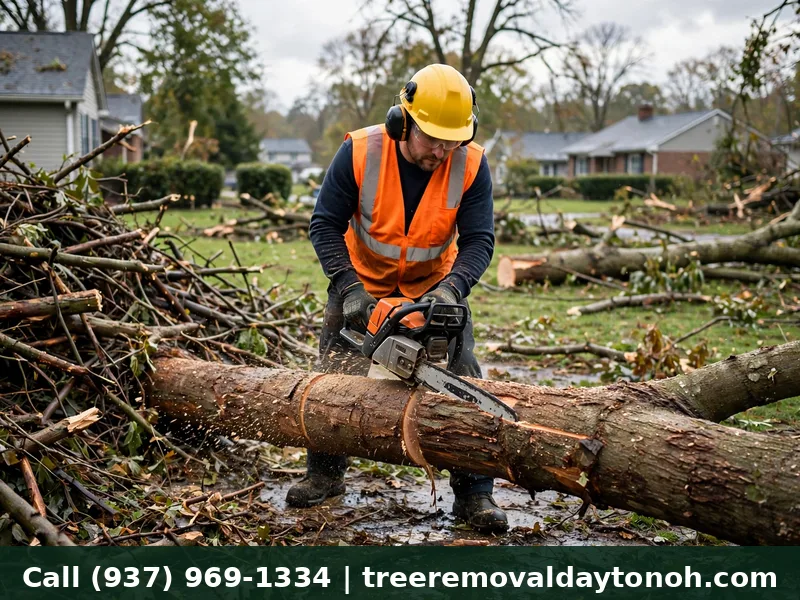
- Make it safe first. Hanging limbs come down by rope. Trees on structures get sectioned and lifted off without dragging across the roof. If a crane is needed for a large tree over a house, we bring one.
- Full removal where needed. Trees that cannot be saved are taken down in controlled sections, with rigging to protect everything around them.
- Complete debris cleanup. Brush is chipped, trunk wood is cut and hauled, and the yard is raked. After a storm you have enough to deal with; the mess should not be one of those things.
Our emergency tree service page has the full details on our 24/7 storm response coverage across the Dayton area.
Do not wait on a leaning tree. Call (937) 969-1334 and we will assess the hazard today.
Storm Cleanup vs Full Tree Removal: What You Are Actually Paying For
Storm invoices confuse people because “cleanup” and “removal” are different jobs with different prices. Here is the breakdown.
| Service | What it includes | Typical situation |
|---|---|---|
| Debris cleanup only | Cutting and hauling fallen limbs and branches already on the ground | Tree survived; yard is a mess |
| Hazard limb removal | Roped takedown of hanging or cracked limbs still in the tree | Partial damage, tree is savable |
| Emergency tree removal | Sectional takedown of a failed or dangerous tree, often off a structure | Split trunk, uprooted tree, tree on house |
| Stump grinding | Grinding the remaining stump below grade | Usually quoted separately after removal |
Emergency work costs more than scheduled work for a simple reason: it happens at night, in bad weather, with a crew pulled off other jobs. That is the price of having someone answer the phone at 2 a.m. and show up with a chipper. For non-urgent storm damage, scheduling a few days out costs less and gets you the same quality of work.
Insurance and Documentation for Storm Tree Damage in Huber Heights
Here is the short version of how insurance treats storm tree damage in Ohio: homeowners policies generally cover tree removal when the tree damages a covered structure, like your house, garage, or fence. They typically do not pay to remove a healthy tree that simply fell in the yard without hitting anything. Debris removal coverage often has a per-tree and per-event cap.
Your documentation decides how smoothly the claim goes. Keep the photos you took before cleanup, keep our written invoice and scope of work, and keep any notes from our crew about the cause of failure. If the tree belonged to a neighbor and fell on your property, document whose tree it was; liability questions come up often after storms.
Read the full walkthrough in our Ohio insurance claim guide for storm-damaged tree removal before you call your adjuster.
Important Considerations for Huber Heights Homeowners
- Do not let anyone talk you into a full removal for minor damage. A tree that lost branches but kept its structure is a pruning job, not a removal job. Get the assessment in writing.
- Beware storm chasers. After every Miami Valley wind event, out-of-area crews knock on doors in Huber Heights offering cheap cash deals. Verify a local address, insurance, and reviews before anyone cuts.
- Silver maples deserve extra scrutiny. Huber Heights has many mature silver maples, and they are brittle. After a storm, have them inspected even if they look fine; internal cracks hide well.
- Check the rest of your trees, not just the damaged one. The same wind that broke one tree stressed the others. A quick post-storm inspection of the whole property is cheap insurance.
- Keep people away from the work zone. When our crew is rigging and cutting, the drop zone is not a spectator area. We will mark it clearly on arrival.
- Plan the replacement. If a storm took your shade tree, fall is the best planting season in Ohio. We can recommend wind-resistant species that handle Miami Valley weather better.
We will make it safe, document it, and clean it up. Call (937) 969-1334 for 24/7 storm response in Huber Heights.
Huber Heights Storm Damage FAQs
Who do I call first when a tree falls on my house in Huber Heights?
Call 911 only if someone is hurt or there is an immediate life-safety hazard. Then call your utility company if any lines are involved, then call us for emergency tree removal. Take photos of everything before any work begins.
How fast can you respond after a storm?
We triage storm calls by hazard level. Trees on houses and blocked driveways get priority, usually same-day. Less urgent damage is scheduled in the order calls come in. Calling early in the day gets you the earliest slot.
Will my homeowners insurance pay for storm tree removal?
Usually yes when the tree damaged a covered structure such as your home, garage, or fence. Coverage for a tree that fell harmlessly in the yard is limited. Document everything with photos and keep our written invoice; our insurance claim guide walks through the process.
Can a storm-damaged tree be saved?
Sometimes. Broken branches on a sound trunk can be pruned back over a season or two. Split trunks, lifted root plates, and severe new leans cannot be fixed safely, and those trees should come down.
Do you clean up all the debris?
Yes. Brush is chipped, trunk sections are cut and hauled, and the area is raked clean. We do not leave you with a pile at the curb unless you ask us to leave firewood-length pieces.
Do you handle storm damage outside Huber Heights?
Yes. Our emergency crews cover Huber Heights, Dayton, Kettering, Beavercreek, Trotwood, and the surrounding Miami Valley communities around the clock after wind events.
Tree Removal Dayton Ohio is Huber Heights’ local storm response crew, on call 24/7. Call (937) 969-1334 now.