What makes Beavercreek tree work different: Larger lot sizes, wooded rear buffers, and a higher proportion of mature hardwoods including oaks, walnuts, and hickories make Beavercreek jobs more complex than denser suburban areas.
Most common service requested:Tree removal for storm-damaged trees, overhanging oaks near homes, and dead ash trees from the emerald ash borer.
Average cost in Beavercreek: $400 to $3,000 depending on tree size, species, and access. Larger hardwoods on bigger lots often run toward the higher end.
Do Beavercreek residents need a permit: No permit is required for most private property tree removal in Beavercreek. Confirm with the city if your tree is in or near a protected greenway or conservation area.
Fastest service option: Call (937) 969-1334 for same-day estimates and priority scheduling for hazardous trees.
Why Beavercreek Tree Jobs Require Local Knowledge
Beavercreek Ohio is one of the largest cities in Greene County by land area, and its residential neighborhoods reflect that with properties that are significantly larger than those in Dayton’s closer-in suburbs. Many homes in Beavercreek back up to wooded creek corridors, conservation buffers, and natural greenways, which means the trees are often larger and more numerous than in comparable neighborhoods elsewhere in the Miami Valley.
The tree species mix in Beavercreek also skews toward slower-growing hardwoods. Mature red and white oaks, black walnuts, shagbark hickories, and tulip poplars are common on Beavercreek properties, particularly in neighborhoods established before the 1990s. These species are denser, harder to cut, and more expensive to remove than the silver maples and ash trees that dominate other parts of the Dayton metro.
Working around wooded buffers and conservation areas requires knowledge of the city’s greenway boundaries. Some trees adjacent to Beavercreek’s creek corridor protections require coordination before removal even when they are technically on private property.
Free Estimates for Beavercreek Tree Service — Call (937) 969-1334
Common Tree Problems in Beavercreek Ohio
Overhanging oaks near homes and garages are among the most frequent concerns we handle in Beavercreek. White and red oaks that were planted or that grew naturally before surrounding homes were built are now large enough to extend their canopy over structures. Heavy oak limbs over roofs create risk during ice storms and high-wind events that are common in the Miami Valley.
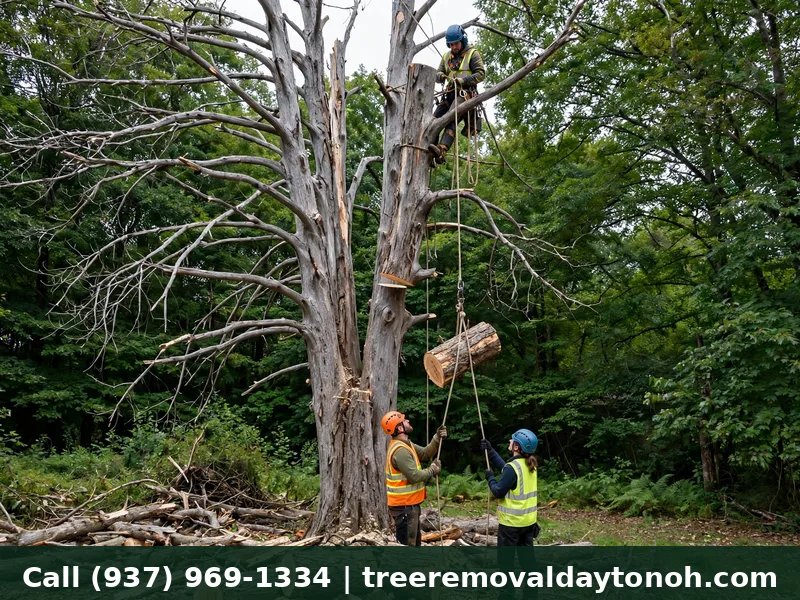
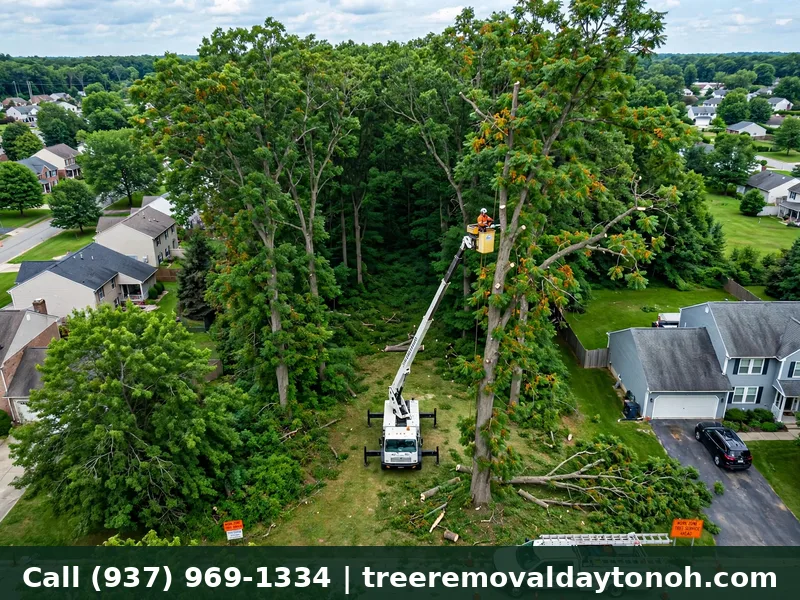
Emerald ash borer has killed a significant portion of Beavercreek’s ash tree population over the past 15 years. Dead ash trees that were not removed promptly are now in an advanced state of decay. Brittle dead ash trees require aerial equipment rather than climbing, which increases removal cost. Any ash tree with visible bark splits, woodpecker activity, or S-shaped galleries under loose bark should be assessed immediately.
Wooded back yards and creek buffers in Beavercreek also produce storm blow-downs more frequently than open suburban yards. When a windstorm comes through, trees at the edge of a wooded area that lose their buffer protection from neighboring removal are at increased risk. This is especially true in the neighborhoods along Beavercreek’s eastern edge near the Greene County border.
How Much Does Tree Service Cost in Beavercreek Ohio?
Tree removal in Beavercreek Ohio ranges from $400 for small ornamental trees to $3,000 or more for large mature hardwoods like oaks and walnuts. The higher cost in Beavercreek compared to neighboring areas reflects the larger average tree size and the more complex access situations on larger lots with wooded boundaries.
Tree trimming and pruning for crown reduction, dead wood removal, or clearance trimming typically runs $200 to $800 per tree depending on height and canopy density. Oaks require more careful pruning than fast-growing softwoods because improper cuts can introduce disease and weaken the branch attachment structure.
Emergency call-outs after storm events in Beavercreek carry a premium of 25 to 50 percent over standard rates because of the response priority and after-hours or weekend scheduling that storm emergencies require. However, this depends on the nature and timing of the emergency.
Oak trees in Beavercreek require specific timing for pruning to avoid oak wilt disease. Oak wilt is a fungal disease transmitted by sap beetles that are active from April through July in Ohio. Pruning cuts made during this window are more likely to attract beetles carrying the fungus from infected trees.
The recommended window for oak pruning in Ohio is August through March when sap beetles are not active and fresh cut wounds are not as attractive to the vector insects. If an oak limb breaks in a storm during the active season, apply wound sealant to fresh cuts immediately as a precaution, though sealant is not a guarantee against infection.
Dead oak branches can be removed at any time of year. The oak wilt risk applies specifically to live wood pruning cuts and storm wounds that expose fresh wood. However, if oak wilt is already present in a tree, immediate consultation with a certified arborist is required to contain spread to neighboring oaks.Beavercreek Neighborhoods We Serve
We regularly work throughout Beavercreek including the neighborhoods along Dayton-Xenia Road, the sections near Beavercreek High School along Grange Hall Road, the residential areas around Young’s Jersey Dairy in Yellow Springs Road, and the newer developments off Kemp Road and Factory Road in the eastern city limits.
We also serve properties along the Little Beaver Creek corridor and the greenway buffers where large hardwoods are most common. We are familiar with where the city’s tree protection areas are and can advise on what approvals are needed for trees near these boundaries.
Commercial properties along North Fairfield Road and the Beavercreek Town Center area are also part of our regular service territory for storm response, routine trimming, and clearance work near commercial signage and structures.
Important Considerations
Beavercreek’s wooded buffers along Beaver Creek and its tributaries are subject to state and local protections. Removing trees within 50 feet of a waterway may require permits from the Ohio EPA or Army Corps of Engineers depending on the scope of work. Do not remove trees in riparian buffer areas without confirming permit requirements first.
Black walnut trees in Beavercreek carry additional considerations. Walnut wood has high commercial value, and some homeowners prefer to have walnut logs milled rather than chipped. Discuss this preference with your tree crew before removal begins.
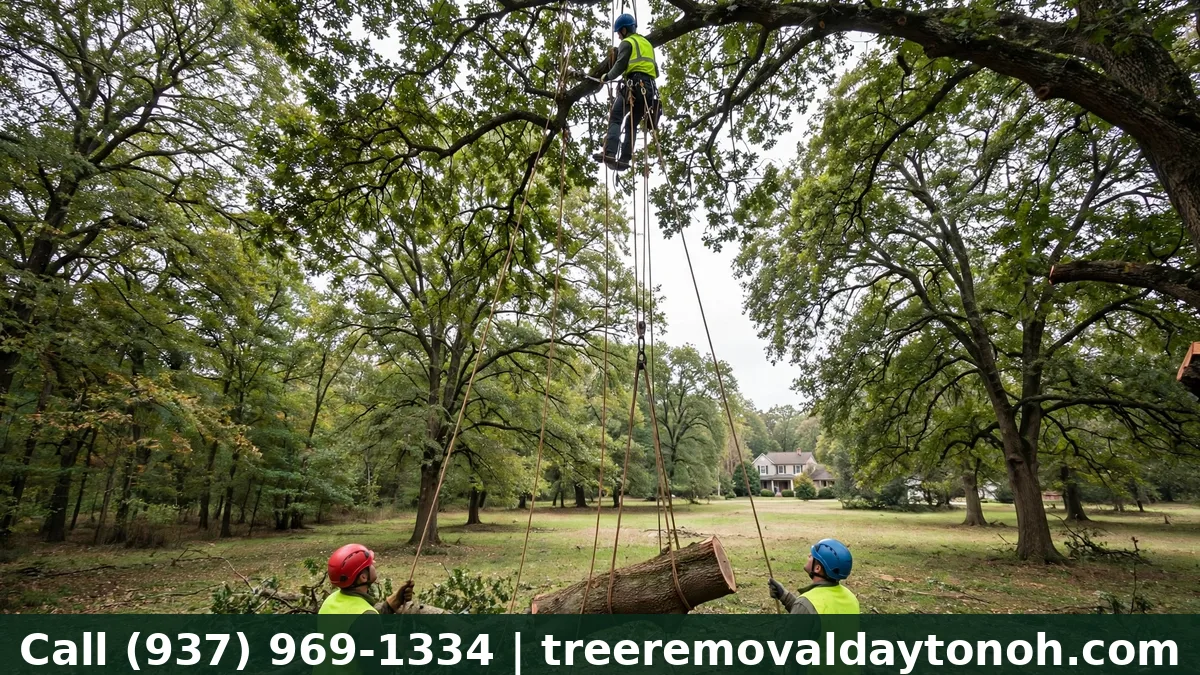
Large tree removals on steep lots near creek banks require additional rigging and sometimes crane support to prevent debris from sliding into the waterway. This is reflected in the higher cost of creek-adjacent removals.
Frequently Asked Questions
Do I need a permit to remove a tree in Beavercreek Ohio?
Most private property tree removal in Beavercreek Ohio does not require a permit. However, trees near the city’s designated greenway corridors or within 50 feet of a waterway may require approval under Ohio EPA or local ordinance. The City of Beavercreek does not have a blanket private tree removal ordinance as of 2026, but regulations can change. Confirm with the Beavercreek Planning Department if your tree is near a conservation area. This depends on the specific location.
What is the best time of year for tree removal in Beavercreek?
Late fall through early spring is the best time for tree removal in Beavercreek because trees have dropped their leaves, making the canopy smaller and the structure easier to see. Ground conditions are often firmer in late fall before ground freeze, reducing equipment damage to lawns. For oak trees, avoid pruning from April through July to reduce oak wilt risk. However, emergency removals and removal of dead trees are appropriate at any time of year.
Can I keep the firewood from a removed tree in Beavercreek?
Yes. Most tree services will leave cut logs on site if you want the firewood. Discuss this before the job starts so the crew cuts logs to a manageable length and stacks them where you want them. Hardwood species from Beavercreek, including oak, walnut, and hickory, produce excellent firewood that burns hot and long. However, fresh-cut wood needs 6 to 12 months of seasoning before it burns efficiently.
Does Tree Removal Dayton Ohio provide arborist services in Beavercreek?
Yes. We provide full tree removal, trimming, stump grinding, hazard assessment, and emergency storm response throughout Beavercreek Ohio. Our team includes ISA Certified Arborists who can assess tree health and provide written reports when needed for insurance or HOA purposes. Call (937) 969-1334 for a free on-site estimate
TL;DR: Cottonwood Removal in the Dayton Area Cottonwoods (Populus deltoides) are native along the Great Miami River and the creeks around Miamisburg and Fairborn. They grow up to 6 feet a year, reach 80 to 100 feet tall, and live 70 to 100 years. Fast growth means weak wood. Worry about the tree leaning toward…
TL;DR: Centerville Tree Service at a Glance Most Centerville calls are Bradford pear failures, storm-damaged limbs, and trees that outgrew their planned community lots. Bradford pears split at their weak V-shaped unions. In Centerville, we usually recommend removal plus a stronger replacement tree. HOA and planned community properties need tree work done cleanly: same-day debris…
TLDR Why Oakwood is different: Oakwood has dense historic homes, narrow lots, mature oaks and silver maples, brick driveways, and strict protection for landscaping and structures. A standard removal crew is not enough. You need specialist rigging, ground protection, and careful sectional work. What specialist crews do: They remove trees in small controlled pieces, lower…
TLDR Most removed tree in Kettering: Silver maple, followed by ash trees affected by emerald ash borer, and aging Bradford pear trees in residential neighborhoods. Biggest challenge in Kettering tree removal: Tight side yards and older wooden fences limit equipment access, requiring hand-carry of debris in many residential jobs. Cost range for tree removal in…
TL;DR: Tree Removal in Huber Heights, Ohio Most tree removals in Huber Heights involve silver maples planted when the subdivisions were built: weak wood, co-dominant stems, and roots that find sewer laterals. Typical residential removal costs run $900 to $3,500, depending on tree size, location, and whether a crane is needed for tight lots. Many…
TL;DR: Tree Removal in Springboro Ohio Bradford pears are the number one tree we remove in Springboro. Their weak V shaped branch unions split apart in storms, and most of these trees only live 20 to 25 years. Ohio has restricted the sale of Callery pear varieties since 2023, so replacing a failed pear with…


 Beavercreek Neighborhoods We Serve
We regularly work throughout Beavercreek including the neighborhoods along Dayton-Xenia Road, the sections near Beavercreek High School along Grange Hall Road, the residential areas around Young’s Jersey Dairy in Yellow Springs Road, and the newer developments off Kemp Road and Factory Road in the eastern city limits.
We also serve properties along the Little Beaver Creek corridor and the greenway buffers where large hardwoods are most common. We are familiar with where the city’s tree protection areas are and can advise on what approvals are needed for trees near these boundaries.
Commercial properties along North Fairfield Road and the Beavercreek Town Center area are also part of our regular service territory for storm response, routine trimming, and clearance work near commercial signage and structures.
One Comment