
Signs a Tree Is Dangerous and Needs to Come Down — Dayton Ohio Guide
Quick Answers — Dangerous Tree Warning Signs
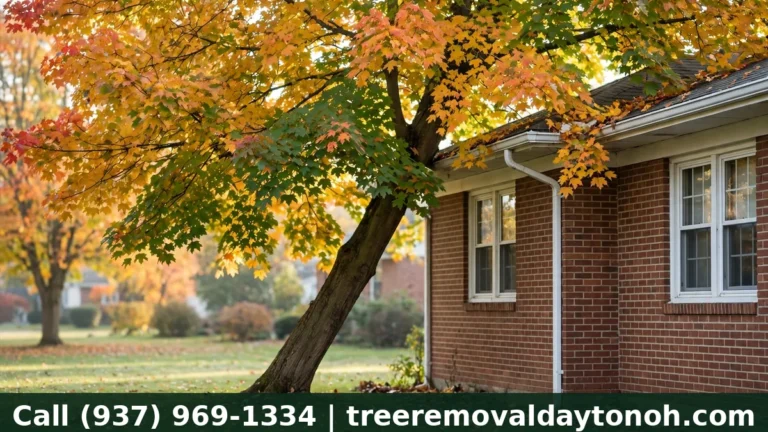
Most urgent sign: A sudden unexplained lean toward a structure — requires immediate professional assessment.
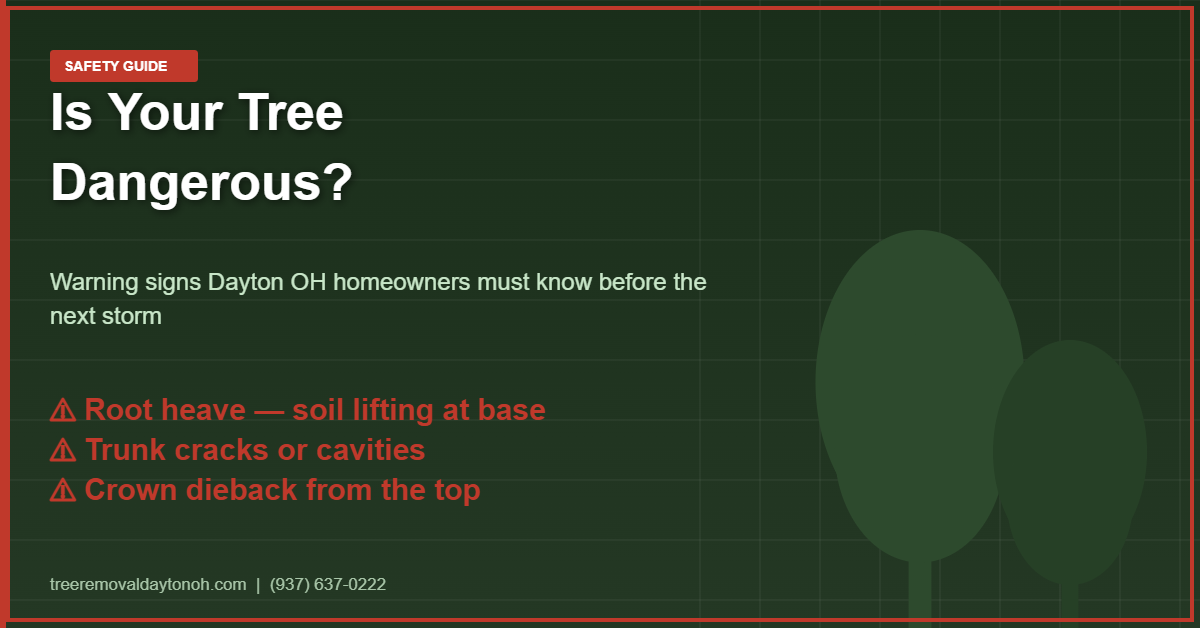
Root signs: Soil heaving at the base, fungal growth at roots, or dead surface roots.
Trunk signs: Vertical cracks, hollow-sounding trunk, cavities, or shelf fungus on the bark.
Canopy signs: Dieback starting at the top, dead branches over 2 inches diameter, or a “lion’s tail” appearance.
Post-2019 tornado: Trees in Trotwood and surrounding areas that were bent or partially uprooted in 2019 should be professionally assessed.
Free assessment: Call (937) 969-1334 — ISA Certified Arborist on staff.
A dangerous tree in Dayton, Ohio shows warning signs across three areas: the root zone, the trunk, and the canopy. No single sign is always definitive — risk assessment requires evaluating the combination of signs, the tree’s structural condition, and what is in the fall zone. A tree over an occupied bedroom is a different risk profile than the same tree over an empty yard. For a free on-site assessment, call (937) 969-1334.
Root Zone Warning Signs
Soil heaving around the base — where the ground appears to lift on one side — is one of the most serious root warning signs. It indicates the root system is beginning to fail, often preceding a full topple within weeks or months. Soil heaving after a storm is especially serious, as wind loading may have already partially broken the root anchorage.
Fungal growth — mushrooms or shelf-like conks — around the base or on surface roots indicates internal root decay. By the time fruiting bodies are visible at the surface, significant internal decay has typically already occurred. However, not all mushroom growth near trees indicates danger — some fungi are benign decomposers rather than live-tree parasites.
Trunk Warning Signs
Vertical cracks or seams running up the trunk indicate that internal wood fibres have already separated under load. A trunk with a major vertical crack facing a structure should be assessed urgently — these cracks can propagate rapidly under wind or ice. Cavities encircling more than one-third of the trunk circumference significantly increase failure risk.
Bark that sounds hollow when tapped, excessive bark shedding, and visible shelf fungus (conks) on the trunk all indicate internal decay. Cankers — sunken, discoloured areas on the bark — indicate localised infection that can weaken the trunk at that point.
Canopy Warning Signs
Dieback starting in the upper canopy — where topmost branches die first and the pattern moves progressively downward — indicates root system failure, disease, or systemic pest infestation such as emerald ash borer on ash trees.
Dead branches larger than 2 inches in diameter hanging in the canopy are called “widow makers.” These can fall at any time — not just during storms — and are an urgent hazard when they overhang a play area, driveway, or roof.
Warning Signs by Tree Species in Dayton Ohio
| Tree Species | Primary Warning Signs | Urgency | Common Areas |
|---|---|---|---|
| Silver Maple | Hollow limbs, V-crotch inclusion, sudden lean | HIGH — brittle wood | Huber Heights, Kettering |
| Ash Tree (EAB) | Crown dieback, S-galleries under bark, woodpeckers | URGENT — 3–5 yr death cycle | All Miami Valley areas |
| Bradford Pear | Tight V-crotches, splitting at main stem union | HIGH — fails at 20–30 yrs | Centerville, Springboro |
| White/Red Oak | Sudden branch drop, root fungus, canopy thinning | MEDIUM — slow decline | Oakwood, Kettering |
| Cottonwood | Hollow trunk, root heave near waterways | HIGH — large and fast-failing | Miamisburg, Fairborn |
Post-2019 Tornado: Are Dayton Trees Still Safe?
Trees in the path of the May 2019 Memorial Day tornadoes — particularly in Trotwood, Old North Dayton, and the Harrison Township corridor — may appear healthy while carrying hidden structural compromise. Root systems that were partially torn from the soil can re-establish on the surface while remaining fundamentally weaker. Internal cracks from wind-loading may not be visible externally.
Any tree in these areas that was bent, partially uprooted, or lost significant canopy in 2019 should receive a professional assessment if not inspected since the storm. Delayed tree failure after major wind events is well-documented — trees that survived often fail in subsequent moderate storms 2–5 years later. Call (937) 969-1334 for a free on-site evaluation.
When to Call Emergency Service vs Schedule an Assessment
Call a scheduled hazard tree assessment when you notice warning signs but the tree is not in immediate contact with a structure. Call emergency tree service immediately when the tree is already leaning toward a structure, has suffered acute failure, is in contact with a power line, or soil heave is actively progressing. These are same-day situations.
FAQ — Dangerous Trees in Dayton Ohio
How much does a hazard tree assessment cost in Dayton Ohio?
A hazard tree assessment by an ISA Certified Arborist in Dayton Ohio typically costs $150–$350 for a written assessment of one to two trees. Tree Removal Dayton Ohio provides free on-site visual assessments — call (937) 969-1334. The cost of a fallen tree on a structure far exceeds the cost of a professional assessment.
Can a leaning tree be saved or does it always need to come down?
A leaning tree does not automatically need removal. A tree that has always had a slight lean and is structurally stable is often low risk. A tree that has recently developed a sudden new lean after rain or storm indicates root failure and is a serious hazard. Only an on-site inspection by an ISA Certified Arborist can reliably assess a leaning tree.
Are dead trees always dangerous in Dayton Ohio?
Dead trees are not always immediately dangerous but become progressively more so as decay advances. EAB-killed ash trees in Dayton are particularly brittle once fully dead. Risk depends heavily on the fall zone — the same dead tree is very different risk over an empty field vs an occupied bedroom.
What are the five most dangerous tree warning signs?
The five most dangerous warning signs are: (1) a sudden unexplained lean toward a structure, (2) soil heaving at the base, (3) major vertical cracks in the trunk, (4) dead branches over 2 inches diameter over occupied areas, and (5) visible shelf fungus or conks on the trunk near ground level.
Related Services
If your tree shows dangerous signs, our hazard tree assessment provides a written ISA Certified Arborist report. If removal is needed, our tree removal service handles all sizes. For active hazards, call our emergency tree service line. See our 2026 Tree Removal Cost Guide for pricing.
We serve all of the Miami Valley — Beavercreek, Kettering, Oakwood, Trotwood, Huber Heights, Centerville, and all surrounding areas.
Free Hazard Tree Assessment in Dayton Ohio
Our ISA Certified Arborist assesses every job on-site. Written report available on request.
📍 4049 Dayton-Xenia Rd, Beavercreek OH 45432
📞 (937) 969-1334
Licensed & Insured | ISA Certified Arborist | Free On-Site Assessment