
How to Tell if a Tree Survived a Storm in Dayton: Post-Storm Checklist
TL;DR: Did Your Tree Survive the Storm?
- Walk the 7 point checklist below before you decide anything: lean, root plate lift, hanging branches, bark loss, trunk cracks, canopy loss, and root zone damage.
- A tree that leans more than about 15 degrees after a storm, or shows lifted soil around the roots, is an emergency, not a wait and see.
- Never walk under or climb a storm damaged tree to “get a better look.” Hanging limbs can fall without warning.
- Most healthy trees that only lost small branches recover fully with a cleanup pruning. Trees with major structural damage usually do not recover and should be removed.
- Document everything with photos before cleanup if you plan to file an insurance claim. Call (937) 969-1334 for a free post storm assessment in Dayton.
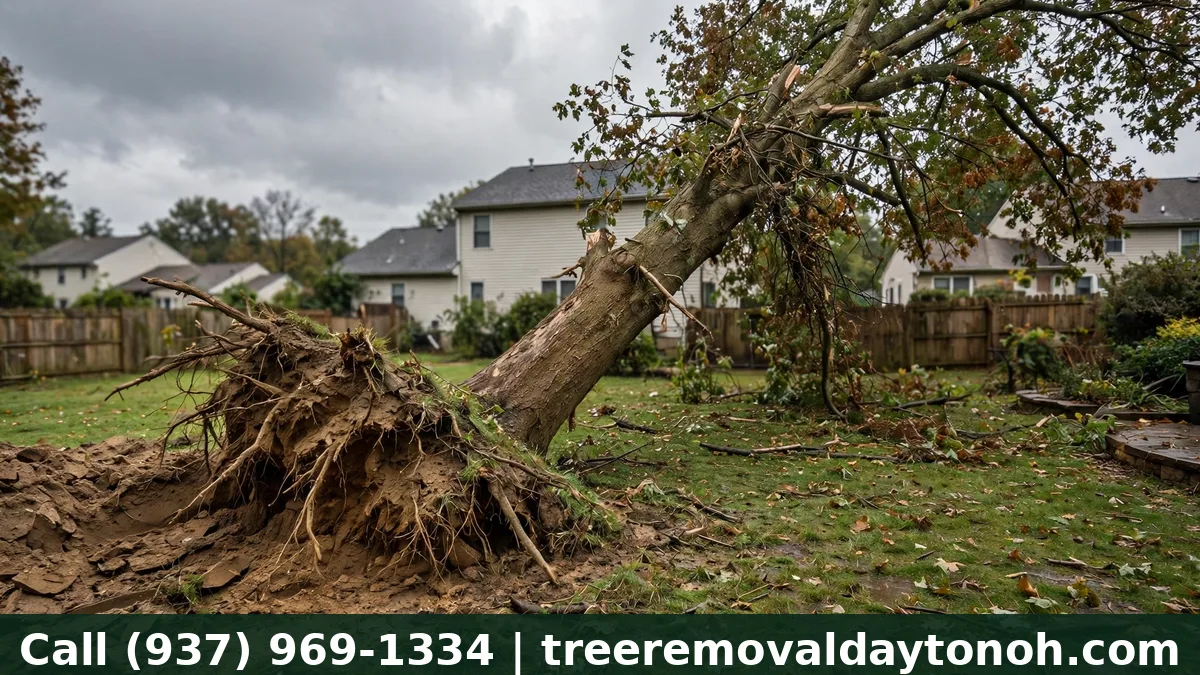
The storm has passed, the wind has died down, and now you are standing in the yard looking up at your trees. Some look fine. One looks wrong, but you cannot quite say how. This is the moment most Dayton homeowners get stuck: is the tree okay, does it need a trim, or is it a hazard that needs to come down?
This post storm checklist is the same sequence our arborists run when we inspect storm damage across the Miami Valley. It takes about fifteen minutes per tree, you do it entirely from the ground, and by the end you will know whether your tree survived, needs professional pruning, or needs removal. If you are dealing with the aftermath of a big wind event right now, start with our emergency tree removal guide for what to do in the first hours.
Storm just came through and something looks wrong? Call (937) 969-1334. We respond to storm damage calls across Dayton the same day.
Check 1: The Lean Test
Stand back far enough to see the whole tree and compare it to how it looked before the storm. A tree that now leans noticeably, especially more than about 15 degrees from vertical, has likely suffered root or trunk failure on the windward side.
A slight new lean on a flexible young tree can sometimes be corrected with staking if the roots are intact. A mature tree that developed a strong lean overnight is a different story: the root system has partially failed, and the tree can fall the rest of the way with no further warning. Treat any significant new lean as urgent and keep people, pets, and cars away from the fall zone. Our guide to dangerous tree signs covers what arborists look for in a leaning tree.
Check 2: The Root Plate
Look at the ground around the base of the trunk, in a circle roughly as wide as the canopy. You are looking for lifted or cracked soil, a visible gap opening between the trunk and the ground on one side, or exposed roots that were not visible before the storm.
Lifted soil means the root plate moved. Even if the tree looks upright, a root plate that shifted in the storm has lost anchoring on one side, and the next wind event can finish the job. Trees with significant root plate movement almost always need removal, because roots do not re anchor reliably once they have torn.
Check 3: Hanging and Broken Branches
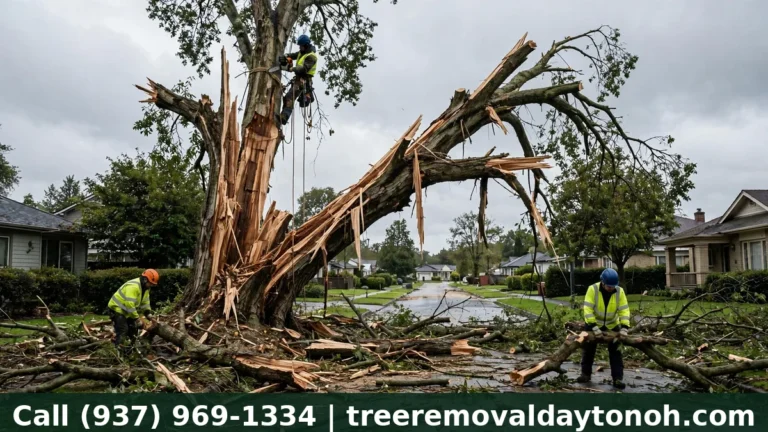
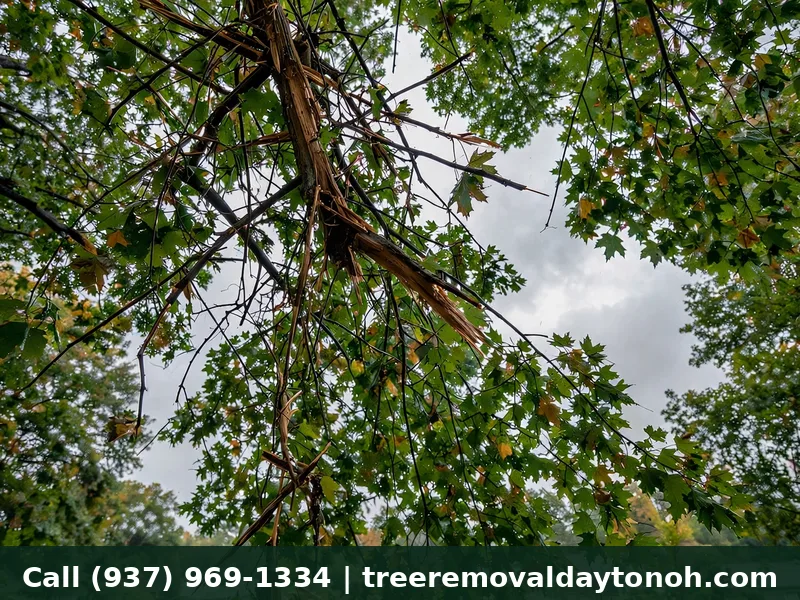
Look up into the canopy for branches that are broken but still caught in the tree, hanging down, or resting across other limbs. These are called hangers or widow makers, and they are the most common cause of post storm injuries.
Do not try to pull them down yourself, and do not stand under them while you look. A cleanup pruning by a professional with the right equipment removes hangers safely and lets the tree start recovering. If the canopy lost more than about a third of its major limbs, the tree may not be worth saving even if the trunk is sound.
Check 4: Bark and Trunk Damage
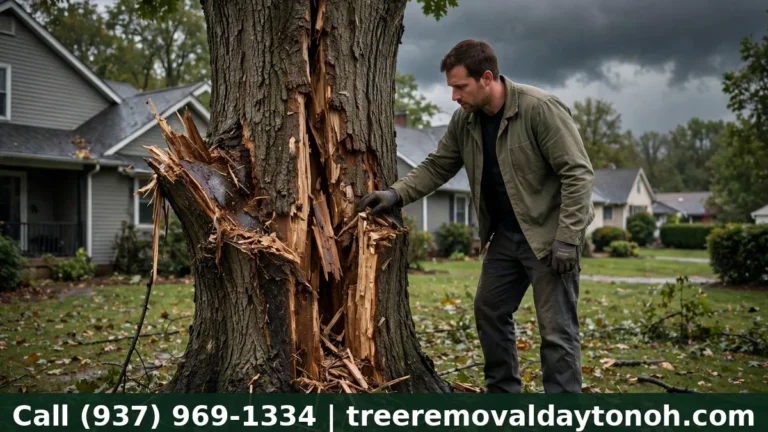
Walk around the trunk and look for long vertical cracks, strips of bark torn away, or deep wounds where a limb tore off. Bark is the tree’s protective skin: large wounds are entry points for decay and insects.
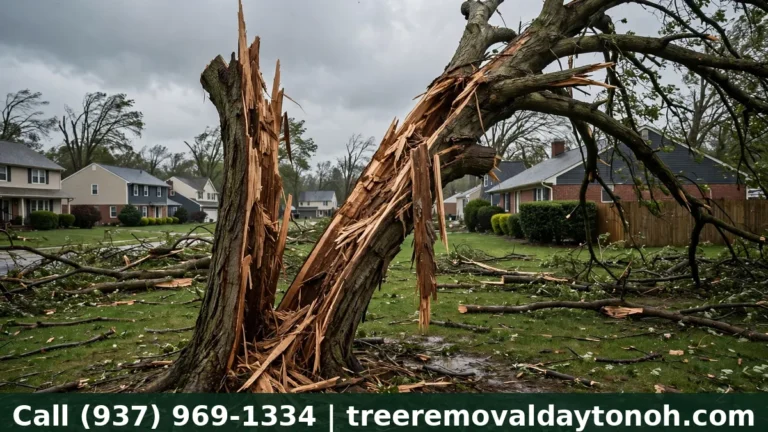
Small bark scrapes on an otherwise healthy tree will usually compartmentalize and heal. But a trunk crack that runs deep, a split that goes through to the interior wood, or bark stripped from more than a quarter of the trunk circumference are serious structural problems. A split trunk on a large tree near your house is a removal call, not a wait and see. See our hazard tree assessment for how arborists evaluate trunk damage.
Check 5: Canopy Loss and Leaf Drop
Note how much of the canopy is gone. A tree that lost a few small branches will leaf out normally next season. A tree that lost half its crown, or one whose remaining leaves are suddenly wilting and browning in the days after the storm, is telling you the damage goes deeper than the branches.
Sudden leaf wilt after a storm often means root damage or a major vascular injury that you cannot see from outside. Give it two to four weeks and watch: a tree that is pushing new growth is recovering, while a tree with spreading dead zones is declining. Do not fertilize a storm stressed tree to “help it recover.” Extra nitrogen on a damaged root system does more harm than good.
Check 6: The Root Zone
The root zone extends well past the trunk, so check the ground out to the drip line. Look for new cracks in the soil, areas where the ground feels spongy or sunken, and any construction or trenching damage that the storm may have worsened. Flooded soil after heavy rain weakens root anchoring for days, which is why some trees fall in the calm after the storm.
Keep heavy equipment, vehicles, and material piles off the root zone while the ground is soft. Compacting wet soil around damaged roots is one of the fastest ways to turn a survivable storm injury into a dead tree.

Check 7: Targets and Risk
Finally, look at what the tree could hit if it fails. A damaged tree in the middle of a big backyard is a different risk calculation than the same tree leaning toward your bedroom or the neighbor’s garage. Be honest about targets: house, driveway, power lines, play areas, sidewalks, fences.
A tree with moderate damage and high value targets is a removal or heavy reduction candidate. The same damage on a tree with no targets might just need monitoring. Risk is damage plus targets, never damage alone. If the tree is anywhere near power lines, do not touch it and call the utility first.
Your Results: Recover, Prune, or Remove
| What you found | What it means | Next step |
|---|---|---|
| Only small branches down, no lean, bark intact | Tree survived | Cleanup pruning, monitor for one season |
| Hanging limbs, minor bark wounds, canopy mostly intact | Recoverable with help | Professional pruning to remove hazards |
| New lean under 15 degrees, slight soil cracking, no targets | Borderline | Arborist inspection, possible cabling or monitoring |
| Lean over 15 degrees, lifted root plate, split trunk | Structural failure | Removal, treat as urgent if targets exist |
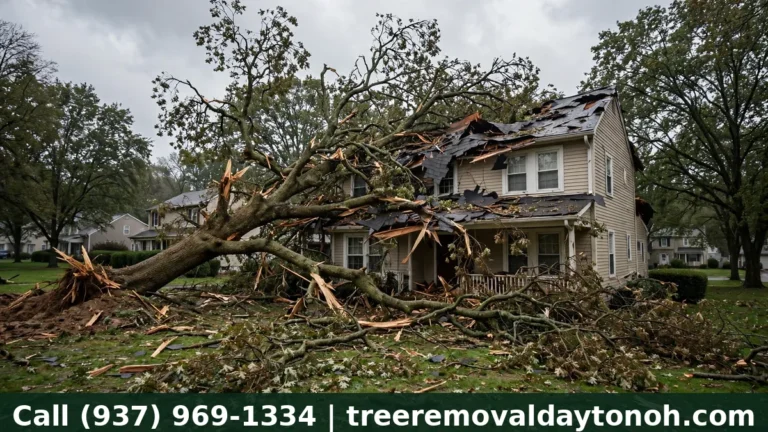
| Tree on a house, car, or wires | Emergency | Call immediately, do not approach |
Not sure which row your tree falls in? Call (937) 969-1334. A free on site assessment settles it in minutes, and there is no obligation.
What Not to Do After a Storm
- Do not climb a storm damaged tree. Damaged wood behaves unpredictably, and hangers fall without warning. Leave canopy work to equipped professionals.
- Do not top the tree to “make it safe.” Topping creates weak regrowth and guarantees future failures. Proper reduction pruning is the correct alternative.
- Do not ignore a tree that “looks fine.” Root damage and internal cracks are invisible. Run the full checklist on every large tree near a target, not just the obviously broken ones.
- Do not clean up before documenting. If there is any chance of an insurance claim, photograph everything first. Our insurance claim guide walks through what adjusters need to see.
- Do not hire the first truck that knocks. Storms bring out door to door scammers. Verify licensing, insurance, and local reputation before anyone touches your trees. Our tree service scam guide lists the red flags.
Important Considerations
- Some failures happen days later. Waterlogged soil and slowly tearing roots mean a tree can fall in the calm after the storm. Keep monitoring for at least a week, especially after heavy rain.
- Healthy trees usually survive. Most storm losses in Dayton are trees that were already compromised: decayed trunks, weak unions, root damage from construction. That is why preparing trees before tornado season matters so much.
- Document first, clean up second. Photos of the damage before any work starts are the foundation of a successful insurance claim. Date stamped phone photos are fine.
- When in doubt, get an arborist out. A free assessment costs you a phone call and settles the question definitively. Call (937) 969-1334 and we will come look.
FAQs
How can I tell if my tree is okay after a storm?
Run the seven point checklist: lean, root plate, hanging branches, bark and trunk damage, canopy loss, root zone, and targets. A tree with no new lean, intact bark, and only small branch loss is almost certainly fine.
How long should I wait to see if a tree recovers?
Give it two to four weeks and watch for new growth. A tree pushing new leaves is recovering. Spreading dead zones, sudden wilt, or worsening lean mean the tree is declining and needs professional evaluation.
Is a leaning tree after a storm always dangerous?
Not always, but a new lean of more than about 15 degrees on a mature tree, or any lean with lifted soil at the base, is a serious hazard. Young flexible trees with intact roots can sometimes be staked and saved.
Can a tree with a split trunk be saved?
It depends on the split. A shallow bark crack on a healthy tree can heal. A deep split through the interior wood, especially on a large tree near a target, almost always means removal. Cabling can help borderline cases but does not fix a truly split trunk.
Should I file an insurance claim for storm tree damage?
If the tree damaged your house, fence, or other structures, or if removal is required to prevent further damage, a claim is usually worth filing. Photograph everything before cleanup and read our Ohio insurance claim guide first.
What does post storm cleanup cost in Dayton?
Simple debris and branch cleanup runs a few hundred dollars. Professional pruning of storm damage typically runs $400 to $1,200 depending on tree size. Full removal of a storm damaged tree runs $800 to $3,500 or more for emergency work. See our cost guide for details.
Who do I call for a tree on power lines after a storm?
Call the utility company first, then a tree service once the lines are confirmed safe. Never touch a tree touching power lines yourself. Our emergency tree service coordinates with utilities on these jobs.
Storm damage in Dayton and not sure your tree made it? Call (937) 969-1334. Tree Removal Dayton Ohio offers free post storm assessments, and we will tell you honestly whether your tree survived or needs to come down.