
Tree Removal Near Power Lines in Dayton Ohio: What You Need to Know
TLDR
- Who owns the power line: AES Ohio (formerly Dayton Power and Light) owns and maintains the distribution lines running along streets. The service drop from the pole to your home is different, and responsibility for trees near it depends on location.
- Can you trim a tree touching power lines yourself: No. Never attempt to trim or remove a tree that is touching or within 10 feet of a power line. Contact AES Ohio or hire a certified line-clearance arborist.
- Who pays for removal near utility lines: AES Ohio handles trimming along their right-of-way lines at no cost. Trees on private property that encroach on lines are the homeowner’s financial responsibility to have a qualified crew manage.
- How fast does AES Ohio respond: AES Ohio prioritizes downed lines causing outages. Non-emergency trimming requests are scheduled on a rotating cycle, which can take weeks to months.
- What if a tree falls on a power line during a storm: Call AES Ohio at 1-800-433-8500 immediately. Do not approach the line or the tree. Stay at least 35 feet away from any downed wire.
- Can a private tree company work near lines: Only companies with OSHA line-clearance certification are permitted to work within the minimum approach distance of energized lines. Most general tree services are not qualified for this work.
Who Is Responsible for Trees Near Power Lines in Dayton Ohio?
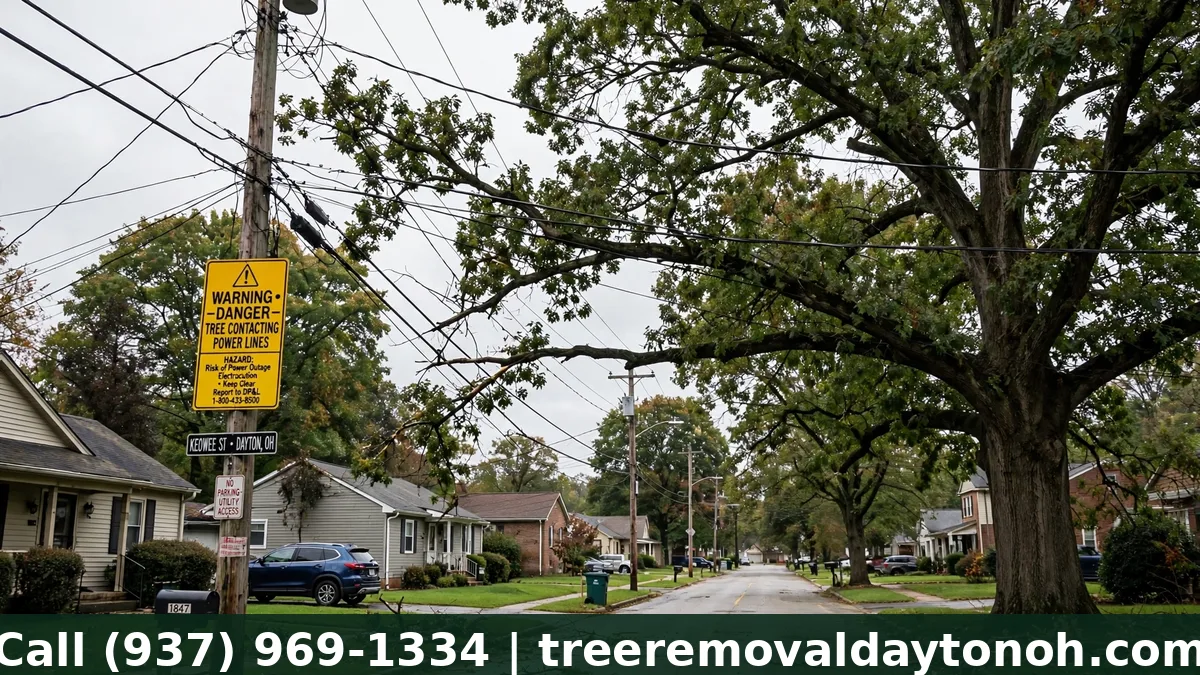
Responsibility for trees near power lines in Dayton Ohio depends on where the tree is located and which line it is growing toward. AES Ohio, the local electric utility, is responsible for maintaining clearance along their distribution lines that run along public rights-of-way and between utility poles.
Trees growing on your private property that are overhanging or touching the service drop, which is the lower-voltage line running from the utility pole to your home, fall into a shared zone of responsibility. AES Ohio does not routinely trim private trees away from service drops. That trimming is typically the homeowner’s responsibility and requires a qualified tree crew.
If a publicly owned tree along a road or sidewalk is growing into utility lines, contact the City of Dayton or your specific municipality’s public works department. The city handles trees in their right-of-way separately from AES Ohio’s utility right-of-way maintenance.
Tree Near a Power Line? Call (937) 969-1334 — We Work With Certified Crews
Is It Legal to Trim a Tree Near Power Lines in Ohio?
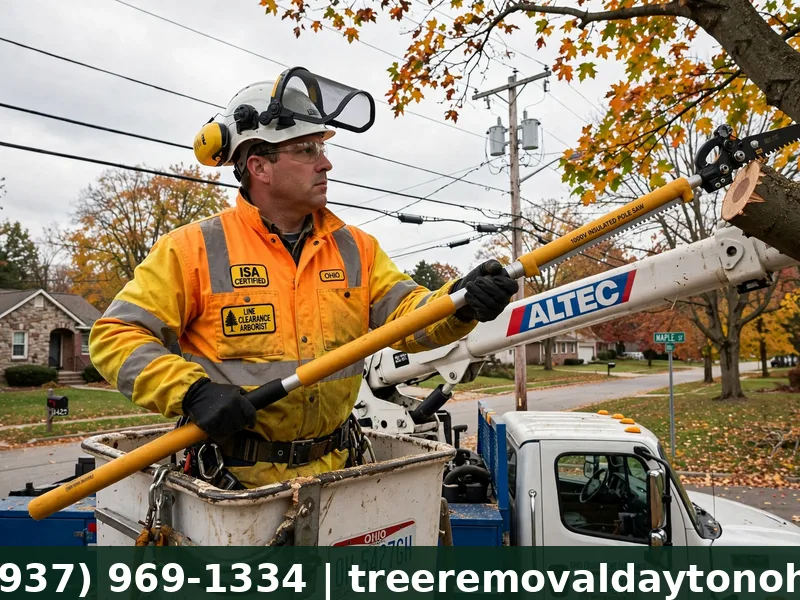
Ohio law and OSHA regulations prohibit unqualified workers from working within 10 feet of energized power lines. This applies to homeowners, general contractors, and tree services that do not hold line-clearance arborist certification.
Line-clearance arborists undergo specific OSHA training for working near energized conductors and use specialized personal protective equipment and rigging techniques. A standard residential tree service, even one with ISA-certified arborists, is not automatically qualified to work in line-clearance situations.
When you contact a tree company for work near power lines, ask directly whether they hold OSHA 1910.269 line-clearance certification. If they cannot confirm this, they should not be working where branches or ropes could contact energized lines. However, this certification requirement applies to energized lines. De-energized and insulated lines have different approach distance rules.
What Should You Do If a Tree Is Growing Into Power Lines in Dayton?
If a tree on or near your property is growing into distribution lines along the street, report it to AES Ohio through their online outage and vegetation management reporting tool or by calling 1-800-433-8500. AES Ohio schedules trimming through their vegetation management program and will clear lines along their right-of-way without charge to the homeowner.
If a tree on your private property is growing toward your service drop or poses a risk of falling onto lines during a storm, contact a qualified tree service to assess the situation. They will evaluate the proximity to the line and determine whether the work can be done safely without line-clearance certification or whether AES Ohio needs to be involved in de-energizing the line before work begins.
Do not wait until a storm is approaching to address a tree that is already contacting a line. Trees that are already in contact with a line represent an ongoing fire and outage risk, especially during summer dry spells and winter ice storms in the Miami Valley.
| Situation | Who Handles It | Who Pays | Timeline |
|---|---|---|---|
| Distribution line along street | AES Ohio | Utility | Weeks to months |
| Private tree toward service drop | Licensed tree service | Homeowner | Schedule-dependent |
| City-owned tree near lines | City public works | City | Varies by municipality |
| Emergency downed line | AES Ohio emergency crew | Utility | Priority response |
| Tree overhanging neighbor’s lines | Property owner’s responsibility | Property owner | Per service schedule |
How Much Does It Cost to Remove a Tree Near Power Lines in Dayton?
Tree removal near power lines in Dayton Ohio costs more than standard tree removal because of the additional safety requirements and sometimes the need to coordinate line de-energization with AES Ohio. Expect to pay 25 to 50 percent more than the baseline cost of removing a similar tree in an open location.
A small tree under 20 feet near a service drop might cost $500 to $900 to remove safely. A large mature tree within the minimum approach distance of a distribution line can run $1,500 to $4,000 or more, particularly if AES Ohio must be scheduled to de-energize the line before the crew can work.
Some homeowner’s insurance policies cover tree removal near lines when a storm has caused a hazardous condition. Contact your insurer before scheduling removal if storm damage is involved. However, routine removal of a healthy tree that has grown too close to lines is generally not a covered insurance expense.
Get a Line-Clearance Assessment — Call (937) 969-1334 Today
What Happens When a Tree Falls on a Power Line During a Storm in Dayton?
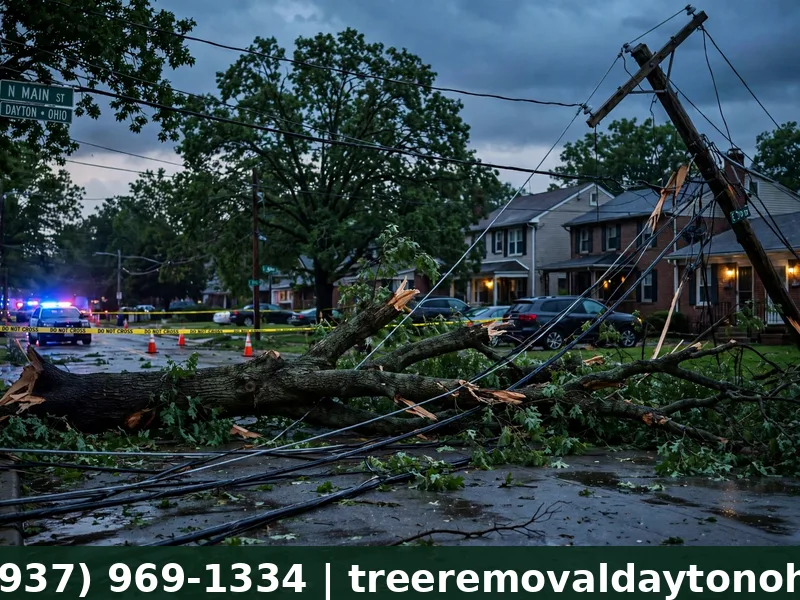
When a tree or branch falls onto a power line during a storm in Dayton Ohio, the line may remain energized even if it is on the ground. A downed power line lying in wet grass or across a wet tree can electrify a wide area around it. Anyone within 35 feet of a downed line is at risk.
The correct response is to call AES Ohio at 1-800-433-8500 and 911 immediately. Move everyone, including pets, away from the area and do not attempt to move the tree or the line. Do not drive over a downed line. Wait for AES Ohio’s emergency crew to de-energize and secure the line before any tree crew approaches the debris.
After AES Ohio has cleared and de-energized the scene, a tree service can then remove the tree debris from the line and your property. This two-step process means storm response near utility lines always takes longer than a standard storm cleanup. However, rushing this process creates life-threatening hazards.
Important Considerations
AES Ohio’s vegetation management schedule operates on a multi-year cycle for each area of their service territory. Being reported as a hazard may move a specific location up in priority, but routine trimming requests may not be addressed for months. In the meantime, monitor a tree near lines closely during storm season and after significant weather events.
If you hire a tree crew to work near your service drop without AES Ohio involvement, confirm that their insurance specifically covers utility work. Standard tree service liability policies sometimes exclude coverage for incidents occurring within a certain distance of power lines.
Never allow anyone to climb a tree that is in contact with a power line. Even dead lines can become energized when other faults occur upstream on the circuit.
Frequently Asked Questions
Will AES Ohio remove a tree that is touching power lines?
AES Ohio will trim branches that are interfering with distribution lines along their right-of-way, but they do not remove entire trees on private property. They trim just enough to establish safe clearance. If the entire tree needs to be removed because of its proximity to the line, that removal is the homeowner’s responsibility and requires a qualified tree crew. However, AES Ohio may coordinate de-energizing the line to allow safe removal in some cases.
Can a tree touching a power line cause a fire?
Yes. A live tree branch or trunk in contact with an energized power line can cause arcing, which may ignite the tree bark or surrounding dry vegetation. This risk increases significantly in dry conditions, particularly during Dayton’s summer dry periods and in fall when leaf litter accumulates near the base. Trees touching lines during ice storms also create added weight that can pull lines down and increase outage and fire risk.
Who pays if a tree falls on a utility line from my yard?
If a tree on your property falls onto a utility line, AES Ohio handles the emergency line repair at their cost. You may be responsible for the cost of removing the tree debris from the line depending on your specific situation and policy. If the tree was visibly dead or hazardous before it fell, your homeowner’s insurance may reduce coverage. Consult your insurer promptly after any tree-on-line incident. However, each situation is evaluated individually.
How close can a tree be to a power line before it is a problem?
Ohio utilities generally target a minimum of 10 feet of clearance between tree branches and distribution lines for routine vegetation management. However, the actual approach distance that creates a safety hazard depends on the line voltage, weather conditions, and the conductivity of the specific wood. Fast-growing trees like silver maples and cottonwoods in the Dayton area can close a 10-foot gap in a single growing season. This depends on the species and the line voltage class.
Does Tree Removal Dayton Ohio work on trees near utility lines?
We assess trees near power lines and work with certified line-clearance crews for situations that require close proximity to energized conductors. For trees near your service drop that do not require AES Ohio involvement, we can handle removal with our standard crew. For trees near distribution lines, we coordinate with AES Ohio as needed before work begins. Call (937) 969-1334 to discuss your specific situation and we will tell you exactly what the process involves.
For warning signs to watch for, see our guide to dangerous tree signs in Dayton Ohio.


4 Comments