

Bradford Pear Trees in Springboro and Centerville Ohio: Why Yours Is About to Fail
TLDR
- Bradford pear lifespan in Ohio: Bradford pear trees have a typical lifespan of 15 to 25 years. Trees planted in the 1990s and early 2000s across Springboro and Centerville are now at or past their failure age.
- Why they fail: Bradford pears have weak branch unions with angles too narrow to support the weight of mature branches. Wind, ice, and their own growth cause them to split structurally.
- Warning sign to watch: If your Bradford pear has developed multiple upright stems from the same base point, it is at serious risk of splitting in the next major storm.
- Is it invasive in Ohio: Yes. Bradford pear and its relatives are on Ohio’s invasive species list. Birds spread seeds from these trees and the offspring crowd out native species.
- Best time to remove: Late fall through early spring when the tree is dormant is the easiest time to remove a Bradford pear. However, emergency removals happen year-round after splits.
- Replacement option: Ohio-native alternatives like serviceberry, redbud, or native plum provide spring flowers without the structural and invasive risks.

Why Bradford Pear Trees Fail in Ohio
Bradford pear trees were widely planted across Ohio suburbs from the 1970s through the early 2000s because of their fast growth, white spring blossoms, and low purchase cost. What nurseries did not advertise was that the tree has a fundamental structural flaw built into its growth habit.
Bradford pears grow multiple upright stems from a central trunk, and those stems form very narrow attachment angles, sometimes as tight as 10 to 20 degrees. Narrow angles create weak bark inclusion points where the wood cannot fully bond. Under the weight of a mature canopy combined with an ice storm or strong wind, those attachment points crack and the entire top of the tree can split.
In Springboro and Centerville Ohio, where most residential Bradford pears were planted between 1990 and 2005, many trees are now between 20 and 35 years old. This puts them squarely in the highest-risk window for spontaneous failure. However, younger trees can also fail if they have developed co-dominant stems early in their growth.
Bradford Pear Concerns? Call (937) 969-1334 for a Free Assessment
What Does a Bradford Pear Failure Look Like?
A Bradford pear failure is almost always sudden and catastrophic. The tree does not lean over weeks or months before splitting. On a calm day or during a moderate wind event, an entire co-dominant stem separates from the trunk at the weak union point and falls without warning.
In residential neighborhoods like Springboro’s HOA communities and Centerville’s older subdivisions, these failures regularly drop 20 to 30 foot sections of tree onto roofs, fences, parked vehicles, and driveways. The resulting clean-up involves not just removing the fallen section but also stabilizing or removing the remaining trunk and root system.
Trees that have already lost one major limb to splitting are at elevated risk of losing additional sections in subsequent storms. A split tree should be assessed by a qualified arborist as soon as possible after the failure.
How to Tell If Your Bradford Pear Is About to Split
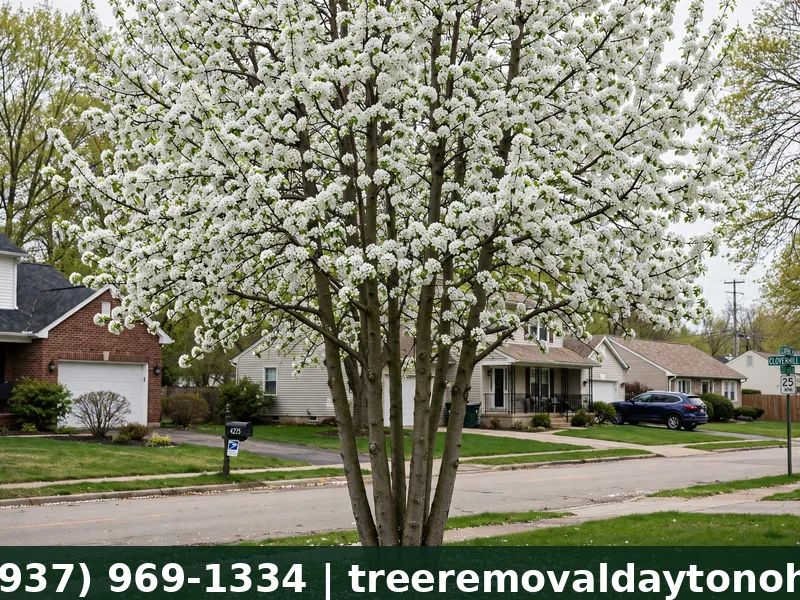
The most visible warning sign is the presence of multiple upright stems growing from a single origin point on the trunk. If you can place your fist between two stems where they meet and feel resistance because they are pressing against each other, the attachment is compromised.
Look for vertical bark cracks running down from the crotch point between two major stems. This indicates that bark inclusion is already occurring and the wood bond is splitting. Any oozing, discoloration, or fungal growth at the union area signals that decay has entered the weak point.
If the canopy of your Bradford pear has visibly widened at the top over the past few years while the trunk has grown thicker, the mechanical stress on those weak unions increases every season. This combination of age, canopy spread, and narrow stem angles creates the conditions for a storm to trigger a split. However, trees in protected locations with smaller canopies may remain stable longer than average.
| Risk Factor | Low Risk | High Risk |
|---|---|---|
| Tree age | Under 15 years | Over 20 years |
| Stem angles | Wide, Y-shaped | Narrow, U-shaped or less |
| Bark at union | Smooth, no cracks | Cracked, oozing, or dark |
| Recent growth | Steady slow growth | Rapid canopy spread |
| Storm exposure | Protected yard | Open to prevailing winds |
Is the Bradford Pear an Invasive Species in Ohio?
The Bradford pear, along with other cultivated Callery pear varieties, is classified as an invasive species in Ohio. The Ohio Department of Natural Resources has flagged these trees for their spread into natural areas, roadsides, and open fields across the state.
Bradford pears are technically sterile on their own, but when they cross-pollinate with other Callery pear varieties that have spread across Ohio neighborhoods, the resulting seeds are fertile. Birds eat the small fruits and distribute seeds widely. The offspring that grow from these seeds develop thorns and spread aggressively into natural areas where they crowd out native wildflowers, shrubs, and tree seedlings.
Ohio has joined several other states in banning the sale and planting of Callery pear varieties. If you are replacing a Bradford pear, choosing a native alternative removes the invasive reproduction risk entirely.
Ready to Remove Your Bradford Pear? Call (937) 969-1334 Today
What to Plant Instead of a Bradford Pear in Ohio
Ohio native trees provide the same ornamental benefits as Bradford pear without the structural or invasive problems. Serviceberry (Amelanchier) offers white spring flowers, edible berries, and excellent fall color. Eastern redbud provides the same small-scale ornamental presence with pink spring flowers and is widely adapted to Ohio soil conditions.
Native wild plum and chokecherry also provide spring flowering with a native wildlife benefit that Bradford pears do not. For homeowners in Springboro and Centerville who are bound by HOA tree replacement requirements, serviceberry and redbud are commonly approved as compliant replacements.
A newly planted native tree will establish a proper root system within two to three growing seasons and does not carry the narrow stem union risk that makes Bradford pears problematic. However, native alternatives generally grow more slowly than Bradford pear, so visual maturity takes longer.
Bradford Pear and HOA Rules in Centerville and Springboro
Several HOA communities in Centerville and Springboro have added Bradford pear removal to their tree management guidelines following high-profile failures in the area. Some associations now require homeowners to remove Bradford pears over a certain height or that show visible structural warning signs.
Before removing a Bradford pear in an HOA community, review your association’s tree removal and replacement policy. Many HOAs require pre-approval for tree removal and specify a list of approved replacement species. Failing to follow the process can result in fines even when the tree removal was necessary for safety.
Tree Removal Dayton Ohio works regularly in Centerville and Springboro subdivisions and is familiar with the documentation and process most HOAs require. Call us before you start the removal process and we can help you understand what your HOA typically needs.
Important Considerations
Bradford pear failures are sudden and do not always follow storm events. Trees have split on calm days in the middle of summer when the canopy was heavy with leaves and the wood dried out unevenly. Do not assume your tree is safe simply because it has survived multiple storms.
Removing a Bradford pear in the dormant season, from November through February, is generally easier and less expensive because the canopy is smaller. Spring removal during full bloom is possible but requires more care to handle the heavy leaf and flower load.
If a Bradford pear has already partially split and you believe it will fall soon, call an emergency tree service rather than waiting for a scheduled appointment. A partially split tree can drop its remaining top within hours of the initial failure.
Frequently Asked Questions
How long do Bradford pear trees last in Ohio?
Bradford pear trees typically last 15 to 25 years in Ohio before structural failure becomes likely. Trees planted in the 1990s in Springboro and Centerville neighborhoods are now in or past this window. Properly maintained trees with single-leader structure may last longer, but the narrow stem union flaw is built into the tree’s genetics and cannot be fully corrected by pruning. This depends on location, storm exposure, and how the tree was pruned in its early years.
Can you save a Bradford pear tree with cables or bracing?
Cabling and bracing can extend the life of a Bradford pear by reducing the mechanical load on weak stem unions. However, cables require professional installation, annual inspection, and do not eliminate the underlying structural problem. For trees already showing bark inclusion or cracking at the union, cabling is a temporary measure, not a cure. This depends on the degree of existing damage and the tree’s overall health.
Do Bradford pear trees smell bad in Ohio?
Yes. Bradford pear blossoms have a distinctive unpleasant smell that many describe as similar to rotting fish or dirty gym socks. The smell is most noticeable during the 7 to 10 day bloom period in early spring. This is a known characteristic of the Callery pear species and is not a sign of disease or structural problems. However, the smell is temporary and does not affect the tree’s growth or structural risk.
What happens if my Bradford pear falls on my neighbour’s fence?
If your tree falls and damages your neighbour’s property in Ohio, liability generally depends on whether you knew the tree was in poor condition. A tree that was visibly diseased, dead, or structurally compromised before it fell may create liability for the property owner. A tree that appeared healthy and failed unexpectedly is usually treated as an act of nature. However, consult your homeowner’s insurance policy and a legal professional for guidance on your specific situation.
Does Tree Removal Dayton Ohio remove Bradford pear trees in Springboro?
Yes. We remove Bradford pear trees across Springboro, Centerville, and the wider Miami Valley on a regular basis. We handle trees of all sizes including large mature specimens that have partially split. After removal we also offer stump grinding and can advise on replacement options. Call (937) 969-1334 for a free estimate.
For seasonal timing, see our guide to when to trim trees in Ohio and our comparison of stump grinding vs stump removal.

4 Comments