
How to Prepare Your Dayton Property for Tornado Season
TL;DR: Preparing Dayton Trees for Tornado Season
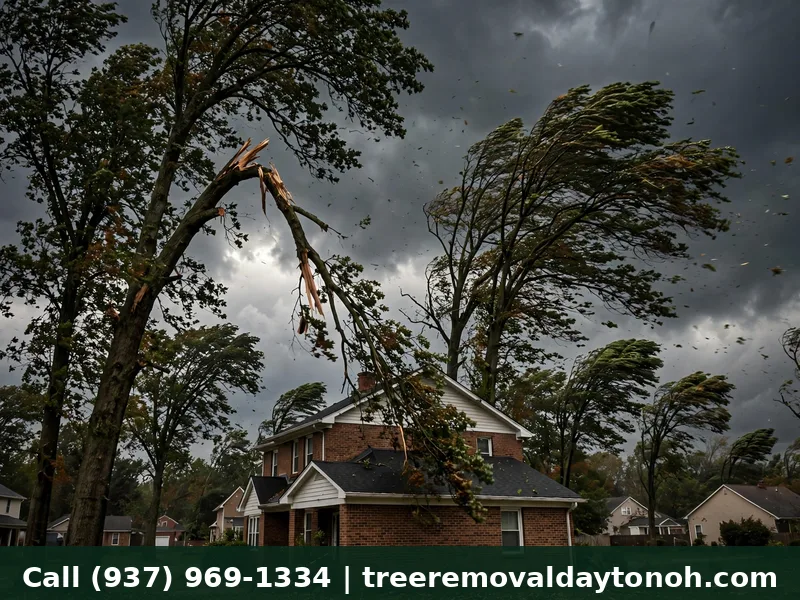
- Tornado season in the Dayton area runs roughly March through July, and most tornado damage to homes actually comes from trees, not the tornado itself: falling trunks and launched branches do most of the destruction.
- The best prep is boring: remove dead wood, thin overgrown crowns, cable or brace weak unions, and take down trees that are already failing. Do it in late winter or early spring before storm season ramps up.
- Know which trees worry you before the storm. A five minute walk around your property with the danger signs below is worth more than any insurance rider.
- Document your trees before storm season. Photos and a quick inventory make insurance claims dramatically easier if something goes wrong.
- Tree Removal Dayton Ohio handles storm prep across the Miami Valley every spring. Call (937) 969-1334.
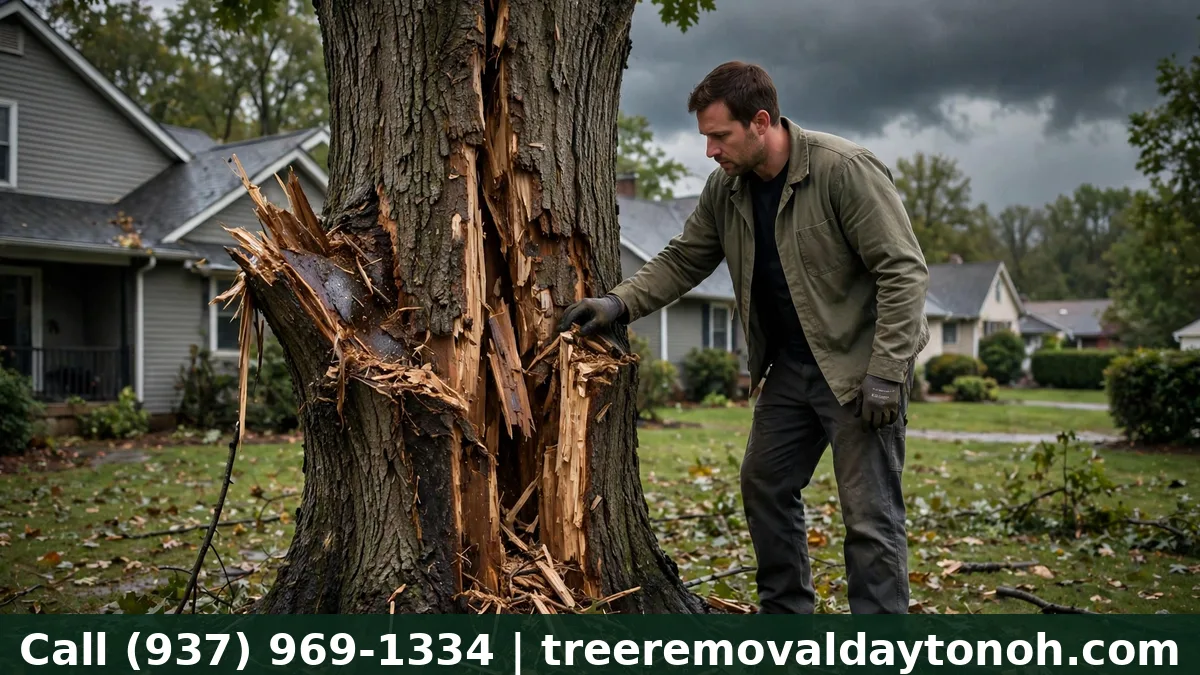
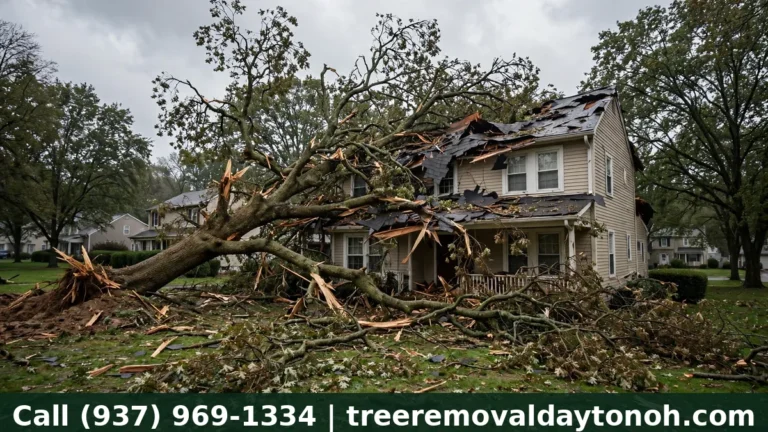
Ask anyone who lived through the 2019 Memorial Day tornadoes and they will tell you the same thing. After the funnel passes, the sound you remember is trees: trunks snapping, limbs punching through roofs, entire root plates tipping over onto cars and fences. Wind gets the headline, but trees do a huge share of the actual damage to homes.
That is the good news hidden in a scary topic. You cannot stop a tornado, but you can absolutely make your trees less dangerous before tornado season arrives. Here is how we prep Dayton properties every spring, and what you can do on your own lot.
Want a professional eye on your trees before storm season? Call (937) 969-1334. We do spring hazard checks across Dayton and the surrounding suburbs.
When Is Tornado Season in Dayton
Ohio tornadoes peak from March through July, with May and June historically the most active months in the Miami Valley. The 2019 Memorial Day outbreak was a reminder that this area can take a direct hit, and since then we have seen plenty of wind events that never touched tornado strength but still brought trees down by the dozen.
Practical takeaway: get your tree work done in late winter or early spring. Crews are less backed up than after a storm, prices are standard instead of emergency rates, and the tree has the growing season to seal its pruning wounds. Waiting until the forecast turns is waiting too long.
The Five Minute Tree Walk: What to Look For
Before you call anyone, walk your property and look at every tree within falling distance of your home, driveway, and any place people gather. You are hunting for these:
- Dead branches still in the crown. Dead wood is the first thing wind throws. If you see gray, leafless branches among green ones, that is a removal target for a trimming visit.
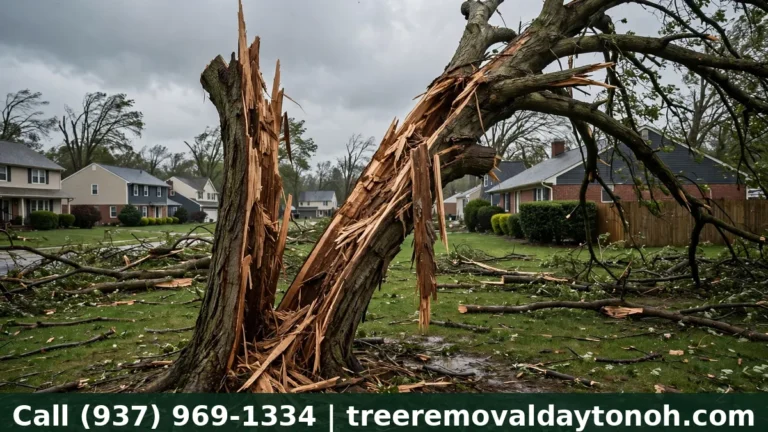
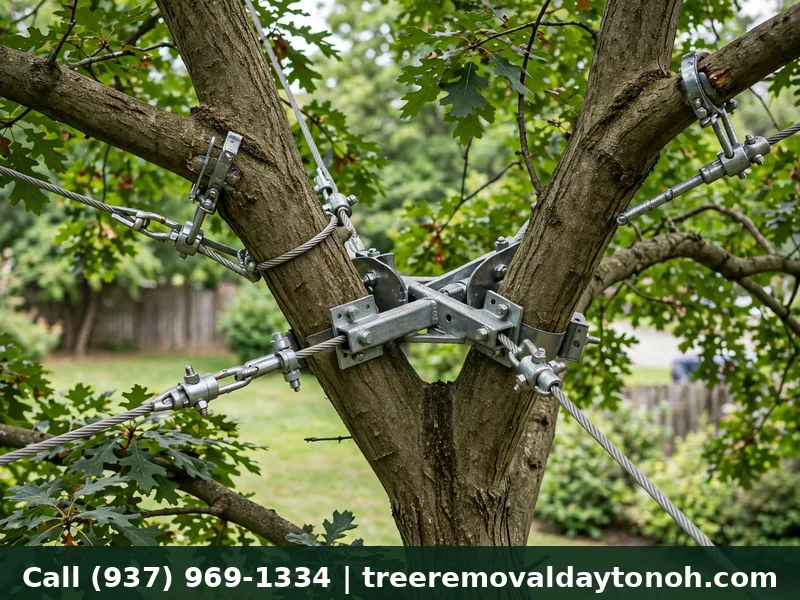
- V shaped unions with bark trapped inside. The classic weak spot. Two trunks or big limbs joined in a tight V with bark pinched between them will split in a wind load. This is the number one failure point we see after storms.
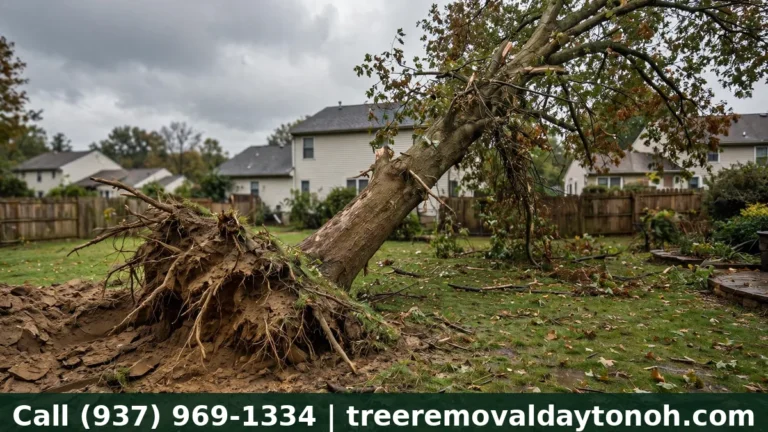
- Lean that is getting worse. Trees lean for reasons, but a lean that has increased since last year, or a tree leaning with fresh soil cracking on the uphill side, is telling you the root plate is failing.
- Cavities and decay at the base. Mushrooms, conks, or soft wood near the ground mean internal rot. A hollow base cannot hold a full crown in high wind.
- Recent construction damage. Trenching, grading, or driveway work through the root zone in the last few years quietly destabilizes trees. The failure shows up later, in the first big storm.
- Power line conflicts. Any tree touching or about to touch lines is a problem for both you and the utility. Our power line tree guide covers who handles what.
If any tree checks two or more of these boxes, stop guessing and get it assessed. Our dangerous tree signs guide goes deeper with photos of each failure pattern, and a hazard tree assessment gives you a professional verdict you can act on.
The Storm Prep Work That Actually Matters
Not all tree work helps in a tornado. Here is what to prioritize, ranked by impact:
| Action | What it does | Best timing |
|---|---|---|
| Deadwood removal | Removes the projectiles wind throws first | Late winter to early spring |
| Crown cleaning and thinning | Reduces sail area so wind passes through instead of pushing | Dormant season or early spring |
| Cabling and bracing weak unions | Supports V shaped unions that would split under load | Any time before storm season |
| Removing high risk trees | Eliminates the threat entirely when a tree cannot be saved | Before March whenever possible |
| Stump and root flare clearing | Reveals girdling roots and hidden decay at the base | During the hazard assessment |
| Lightning protection for specimen trees | Gives lightning a path to ground instead of through the trunk | One time install, check annually |
One thing that does not help: topping. Cutting the top off a tree to make it shorter creates a crown of weak, fast growing sprouts attached to decayed cuts. It makes storm damage worse, not better. See our guide on trees too close to houses for the right way to reduce a crown.
Ready to get your trees storm ready? Call (937) 969-1334. Spring appointments fill up, so book before the busy season.
Special Cases: Which Trees to Worry About First
Some situations deserve priority attention:
- Silver maples and Bradford pears. The two weakest common species in the Miami Valley. If a mature one stands over your roof, it is the first tree to assess every spring. Our silver maple guide explains the failure pattern.
- Dead ash trees. Emerald ash borer has killed ash across Montgomery County. A standing dead ash is brittle and unpredictable in wind. This is a removal, not a trim. Our emerald ash borer guide covers options.
- Trees over bedrooms and living areas. Not every tree near a house is equally dangerous. Prioritize the ones that would land on sleeping areas first.
- Trees near pools, play sets, and patios. People gather under these in summer, which overlaps tornado season. Deadwood removal over gathering areas is non negotiable.
- Post 2019 recovery areas. Neighborhoods hit by the 2019 tornadoes have many trees that survived with hidden damage. A professional look can catch what a visual walk misses.
Document Your Trees Before Storm Season
This step costs nothing and pays for itself the moment you need it. If a storm does damage your trees, the insurance claim goes much faster with documentation:
- Take dated photos of every large tree on your property, from two angles each, showing the full tree.
- Note species, approximate height, and condition in a simple list. Your phone notes app is fine.
- Keep receipts and written estimates from any professional tree work. They prove maintenance, which insurers ask about.
- After a storm, photograph damage before cleanup, get a written assessment, and save every receipt.
If you ever need to file, our storm damage insurance claim guide walks through the Ohio process step by step, including what adjusters look for and the documentation mistakes that slow claims down.
What to Do When the Forecast Turns Bad
No amount of prep helps a tree in a direct tornado hit, so the forecast window is about protecting people, not property:
- Bring in anything the wind can throw: patio furniture, grills, toys, trash cans. Most broken windows in storms come from flying objects, not wind itself.
- Move cars out from under large trees and into the garage if you can.
- Know your shelter spot now, not when the siren sounds. Interior room on the lowest floor, away from windows.
- Never go outside during the storm to check on trees. After the 2019 outbreak, plenty of injuries came from people inspecting damage while conditions were still dangerous.
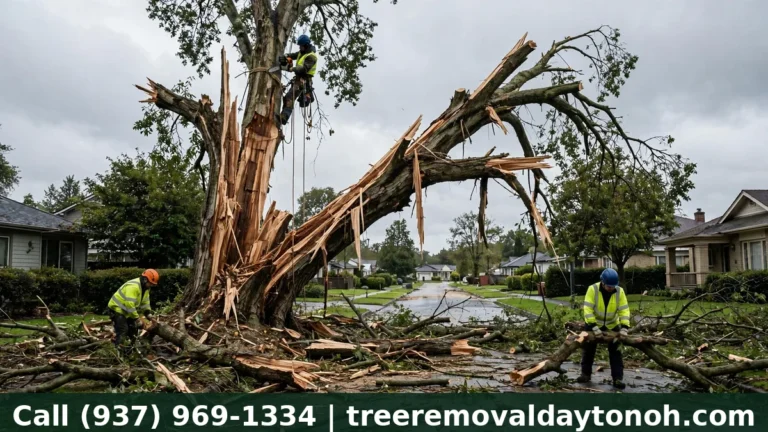
After it passes, do not touch anything near power lines, and call professionals for anything hanging, split, or leaning that was not leaning before. Our emergency tree removal page covers how fast response works, and our Huber Heights storm response post shows what a professional storm cleanup looks like. For immediate help after damage, our emergency tree service runs around the clock.
Important Considerations
- Do storm prep in late winter or early spring. Beating the rush means standard rates, faster scheduling, and work finished before the windy months.
- Deadwood over people and roofs is the single highest value cut. If you do one thing this spring, make it this.
- Cabling saves good trees with weak unions. It is cheaper than removal and preserves a mature tree. Not every tree qualifies, but many do.
- Topping makes storms worse. Never accept topping as storm prep. Proper crown reduction or removal are the real options.
- Document before, photograph after. The insurance claim you prepare for in April is the one that pays out in July.
- After the storm, leave the dangerous work to pros. Hanging limbs under tension and split trunks kill DIYers every storm season. Call (937) 969-1334 instead.
Tornado Season Tree Prep FAQs
When should I trim trees before tornado season in Ohio? Late winter through early spring, ideally February to April. The tree is dormant, crews have availability, and pruning wounds seal before the storm months.
Can trimming actually protect my house from a tornado? Trimming will not save a tree from a direct tornado hit, but most tornado season damage comes from straight line winds and weak storms, not direct hits. Proper pruning dramatically reduces damage from those far more common events.
How do I know if a tree will fall in a storm? Look for dead branches, V shaped weak unions, worsening lean, base decay, and root damage. Two or more signs means get a professional assessment before storm season.
Is tree cabling worth it for storm prep? For a valuable mature tree with a weak union, yes. Cabling costs a fraction of removal and can add decades of safe life. An arborist can tell you if your tree is a candidate.
What should I do right after a storm damages my tree? Stay clear of anything near power lines, photograph everything before cleanup, and call a professional crew for anything hanging or split. Then start your insurance documentation.
Do you offer spring storm prep inspections in Dayton? Yes. We walk the property, flag the high risk trees, and give you a written plan with priorities. Call (937) 969-1334.