

Trotwood Ohio Tree Removal: What We Still See from the 2019 EF4 Tornado
TLDR
- 2019 Dayton tornado in Trotwood: On May 27, 2019, an EF4 tornado with winds up to 170 mph tracked directly through Trotwood, causing catastrophic damage to residential properties and tree canopy.
- Are trees still failing from 2019 damage: Yes. Trees that appeared to survive the 2019 storm with superficial damage have been failing in subsequent storms as hidden internal damage becomes structural failure.
- What delayed tornado damage looks like: A tree that lost a large limb in 2019 but was not removed may now show decay at the old wound site, lean, or crown dieback that was not visible immediately after the storm.
- Most common remaining hazards: Tipped root plates that partially settled back, trees with cracks in the main trunk from the 2019 wind event, and large oaks and silver maples with decay entering old storm wounds.
- What to do if you suspect damage: Have a certified arborist assess any tree on your Trotwood property that went through the 2019 storm path, especially if you notice new lean, crown thinning, or bark cracks.
- Who to call: Tree Removal Dayton Ohio responds to Trotwood emergency and scheduled removals. Call (937) 969-1334.

What Happened to Trotwood’s Trees in May 2019?
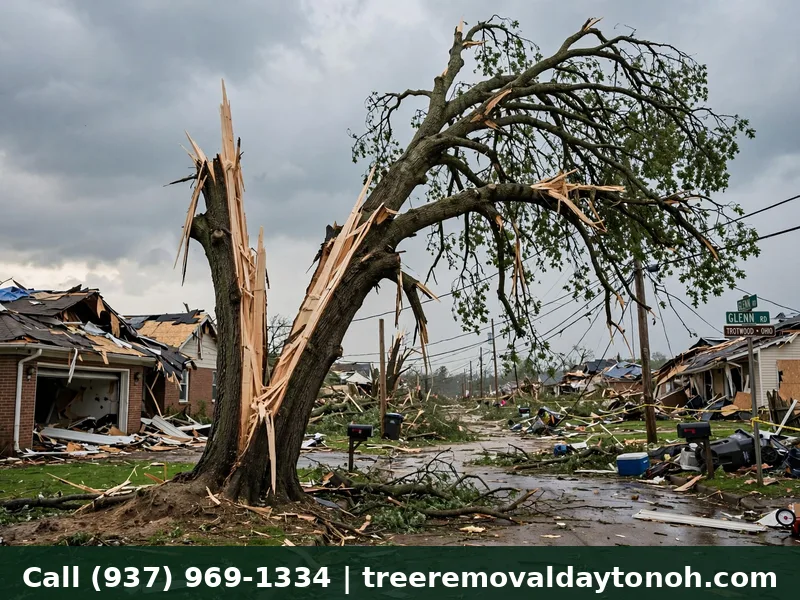
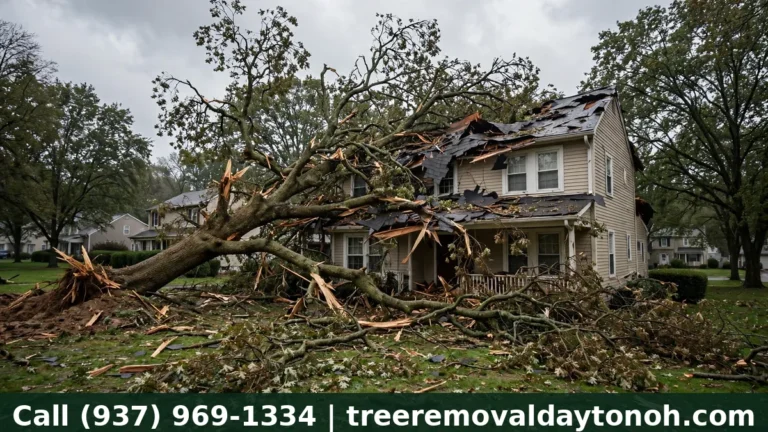
On the night of May 27, 2019, one of the most destructive tornado outbreaks in Dayton Ohio’s history sent multiple tornadoes through the Miami Valley. The EF4 tornado that tracked through Trotwood carried winds estimated at 160 to 170 mph along a path that cut through established residential neighborhoods with mature tree canopy.
The immediate destruction was documented extensively. Tens of thousands of trees were downed, stripped, or snapped across Trotwood, Brookville, and surrounding communities. What received less attention was the trees that survived but sustained structural damage that was not immediately visible. These trees remained standing in 2019, 2020, and in many cases 2021 and beyond, looking essentially intact but carrying hidden structural compromise.
Now, more than six years after the tornado, we are still finding and removing trees across Trotwood that are failing as a direct consequence of 2019 damage. The delay is not unusual. Storm-damaged trees can take 3 to 7 years for internal decay to progress to the point of structural failure, and they often choose the moment of a subsequent wind event to finally come down.
Trotwood Tree Assessment — Call (937) 969-1334 Today
What Delayed Storm Damage Looks Like in Trotwood Trees
A tree that survived the 2019 tornado but sustained damage typically shows delayed failure in one of three ways. The first is crown die-back, where the upper canopy begins thinning progressively in the years after the storm as root system damage from the wind event limits the tree’s ability to sustain its full canopy.
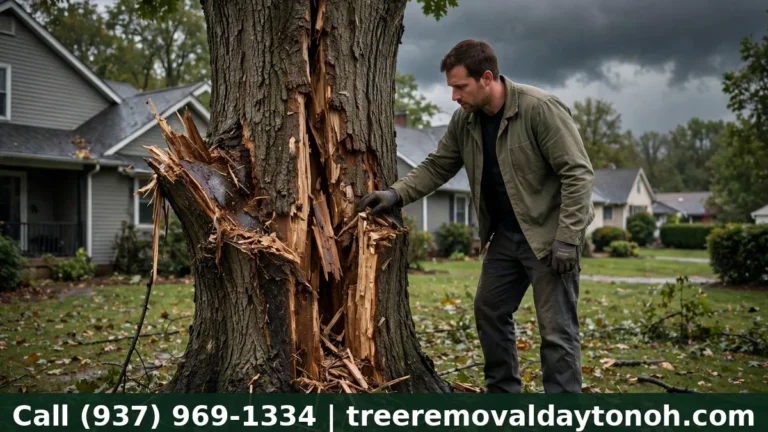
The second pattern is wound decay. Trees that lost major limbs in 2019 and were not treated or removed carry open wounds that have been accumulating decay for six years. Decay that started at a 2019 storm wound can now extend deep into the heartwood of the trunk, compromising the structural core of the tree without being visible from the outside.
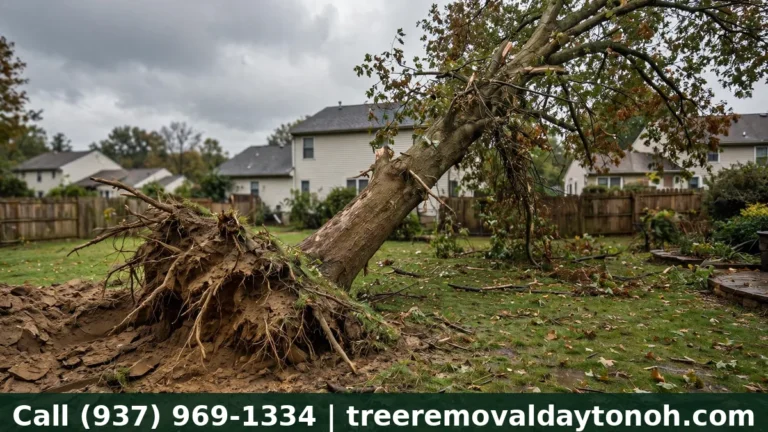
The third pattern is tipped root plates. Trees that partially lifted in the 2019 wind and then settled back down appear to be standing normally but have severely disrupted root systems on the side they tipped away from. These trees have significantly reduced anchoring capacity and are at high risk of full uprooting in the next significant wind event.
How to Assess Your Trotwood Trees for Residual Tornado Damage
Walk the perimeter of any large tree on your Trotwood property that was standing during the 2019 storm. Look for old wounds on the main trunk or primary branches where a limb was stripped or broken in the storm. If those wounds have not closed over with callus bark after 5 to 6 years, decay is likely present in the underlying wood.
Push lightly against the base of the trunk and observe whether the root zone moves. A small amount of movement in a large tree is normal. Visible soil heaving on one side of the root zone, bark that is cracking or separating from the trunk near ground level, or mushroom growth at the base of the trunk are all indicators that the root system or lower trunk is compromised.
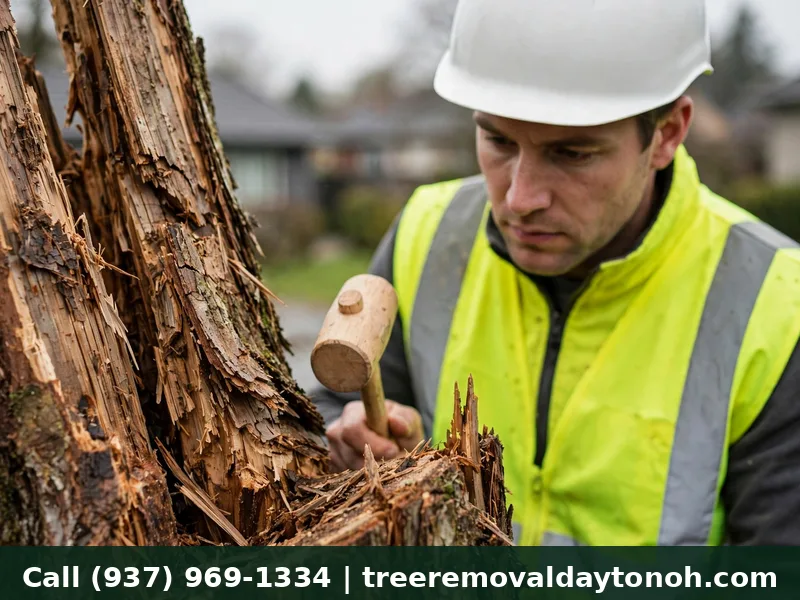
If the crown of the tree looks thinner than it did 2 to 3 years ago without a visible disease explanation, this can indicate root system decline from storm damage that has gradually reduced the tree’s ability to support its canopy. A certified arborist can use a mallet sound test and visual inspection to assess the probability of internal decay without immediately requiring a drill or core sample.
Get a Post-Storm Tree Assessment in Trotwood — Call (937) 969-1334
| Delayed Damage Sign | What It Suggests | Urgency |
|---|---|---|
| Crown thinning since 2019 | Root system decline from wind stress | High |
| Old wounds not closing | Active decay entering trunk | High |
| Mushrooms at base | Decay in root system or lower trunk | Very high |
| Soil heaving on one side | Tipped root plate, reduced anchoring | Very high |
| Bark cracks near 2019 wound | Decay column extending in trunk | High |
| Noticeable new lean | Root or lower trunk failure beginning | Immediate |
The 2019 Tornado Path and Trotwood Neighborhoods Most Affected
The EF4 tornado entered Montgomery County from the northwest and tracked through the residential areas of Trotwood along a path that crossed North James H. McGee Boulevard, Wolf Creek Pike, and the neighborhoods north of West Third Street. The highest-velocity winds in Trotwood were recorded in the northern and western residential sections closest to the tornado’s path centerline.
Neighborhoods along the Trotwood Park area, Olive Road corridor, and the sections near Salem Avenue sustained the heaviest canopy damage. Properties in these areas are the most likely to still have storm-compromised trees that have not been professionally assessed.
Areas on the eastern and southern edges of Trotwood experienced significant but generally lower wind speeds. Trees in these areas were less likely to sustain catastrophic immediate damage but may have experienced enough wind loading to stress root systems and create the slower-progressing failure patterns described above.
Why Storm-Damaged Trees Take Years to Fail
A tree does not fail immediately after storm damage for the same reason a cracked foundation does not collapse the day the crack appears. The structural redundancy built into a living tree, its multiple branching pathways, its living wood surrounding decaying heartwood, and its root system extending far beyond the trunk, allows the tree to continue functioning long after one element is compromised.
Decay organisms, primarily wood-rotting fungi, enter storm wounds slowly and spread through wood at a rate measured in inches per year in most species. A wound that was 2 inches wide in 2019 may have a decay column that is now 6 to 8 inches wide and 12 inches deep. For a large oak or silver maple, this may still be within the structural margin. But in 2 more years after another winter freeze-thaw cycle and another season of growth stress, that same decay column may cross the threshold where the remaining sound wood cannot support the load.
Ohio’s storm cycle also plays a role. The Dayton area sees regular wind events every spring and fall. Each event puts renewed wind load on trees that have been progressively weakening since 2019. The tree that survived the 2019 EF4, a 2021 derecho, and a 2023 spring storm may fail in a 2026 storm that would not have affected it in 2018.
Important Considerations
If you own property in the 2019 tornado path in Trotwood and have not had your trees professionally assessed since the storm, schedule an assessment this year. Six to seven years post-event is within the window where delayed failures from the 2019 damage are most likely to occur.
Insurance coverage for trees that fail years after a storm event may be more limited than coverage for immediate post-storm failures. Consult your insurer about whether storm-origin documentation from 2019 affects current claim eligibility if a compromised tree fails and damages your property.
Trotwood’s recovery since 2019 has involved significant replanting of street trees and park trees by the city and by volunteer programs. These newer plantings are not at risk from 2019 damage but will need routine assessment as they mature over the next decade.
After a Storm: Cosmetic Damage or Structural Failure?
Not every battered tree needs to come down, and not every standing tree is safe. A simple way Trotwood homeowners can judge a storm-damaged tree:
- Usually cosmetic: surface bark scrapes, minor branch loss, stripped leaves. Bark wounds covering less than about a quarter of the trunk circumference generally heal over time.
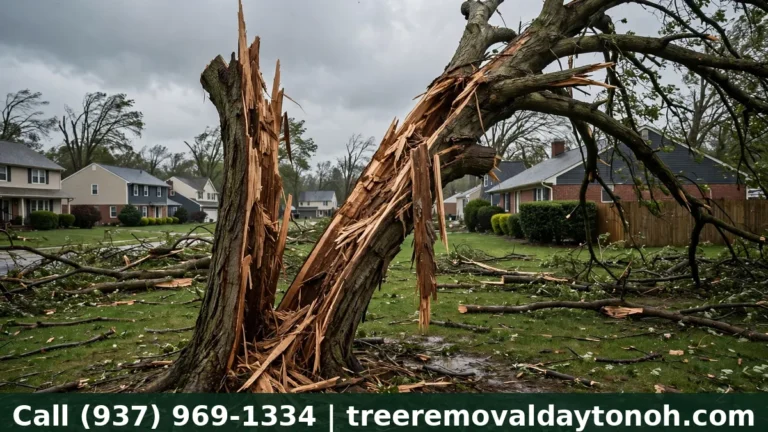
- Usually structural: split crotches where two main limbs or trunks diverge, exposed heartwood, soil heaving or mounding at the base (a shifted root plate), a new lean beyond roughly 15 to 20 degrees, and long vertical trunk cracks.
- Canopy rule of thumb: losing less than about 25 percent of the crown usually recovers with proper pruning. Losing more than half sharply reduces the tree’s ability to heal, and crown loss above 50 percent combined with root or trunk injury generally points to removal.
- Inspect from a distance first: look from 20 to 30 feet away, check the overall silhouette before anything closer, photograph what you see for insurance documentation, and never approach a tree touching a utility line.
Bradford pears and silver maples have weaker wood and recover from major storm damage less often than sturdier native species, which is one reason so many Trotwood Bradford pears failed in 2019.
Frequently Asked Questions
How do I know if my Trotwood tree is about to fall?
Signs that a tree in Trotwood Ohio may be at imminent risk of falling include a visible lean that has developed or increased recently, mushrooms or fungal shelf growth at the base or on the trunk, large dead branches that have not been removed, soil heaving or cracking near the base of the trunk, and bark that is loose or separating from the trunk. Any single one of these signs warrants a professional assessment. Multiple signs together indicate a high-priority removal situation. However, some compromised trees show no external signs until they fail.
Is it too late to file an insurance claim for 2019 tornado tree damage in Ohio?
Standard homeowner’s insurance claims have a filing window that varies by policy but is typically within the policy year of the event. A claim directly tied to the May 2019 tornado would have needed to be filed in 2019 for most policies. However, if a tree that was damaged in 2019 has now fallen and damaged a covered structure, you may have a current-year claim based on the current event even if the root cause was 2019 damage. Contact your insurer directly about your specific situation.
Does Tree Removal Dayton Ohio work in Trotwood?
Yes. We serve Trotwood Ohio for tree removal, hazard assessment, emergency storm response, and stump grinding. We are familiar with the 2019 damage patterns across Trotwood neighborhoods and conduct assessments for post-storm tree health on request. Call (937) 969-1334 to schedule a visit.
Can a tree look healthy but still be about to fall?
Yes. A tree can appear fully leafed out and visually healthy from the street while carrying significant internal decay or root system damage that is not visible externally. This is particularly true for trees with decay in the lower trunk or root plate, where the decay is hidden below the soil surface or behind intact outer bark. Internal decay does not always affect leaf production until the decay column is very advanced. This is why professional assessment with a mallet test and arborist evaluation is more reliable than visual inspection alone.

One Comment