

Hazard Tree Assessment in Dayton: What an ISA Arborist Actually Checks
TLDR
- What it is: A hazard tree assessment is a structured inspection of a tree that might fail and hit something. An arborist checks the roots, trunk, and canopy, then rates the risk and tells you whether to monitor, prune, support, or remove the tree.
- What gets checked: Root flare and soil for rot and lift, trunk and bark for cavities, cracks, seams, and fungal bodies, and the canopy for deadwood, weak unions, and unbalanced weight over targets.
- How risk is judged: Risk combines how likely the tree or a limb is to fail, how likely it is to hit a target such as a roof or walkway, and how serious the damage would be. A rotten tree over an empty field is low risk. The same tree over a bedroom is not.
- What you receive: A clear finding for each concern, photos, and a written recommendation with options and urgency, so you can decide with evidence instead of worry.
- Who to call in Dayton: Tree Removal Dayton Ohio performs hazard tree assessments across the Miami Valley. Call (937) 969-1334.
What Is a Hazard Tree Assessment and When Do You Need One?
A hazard tree assessment is a professional inspection of a tree that could fail and strike a person, a home, a car, or another structure. It is the step between noticing something that worries you and deciding whether the tree truly has to come down. Many trees that look frightening are sound, and some trees that look fine are hollow inside. The assessment replaces guessing with evidence.
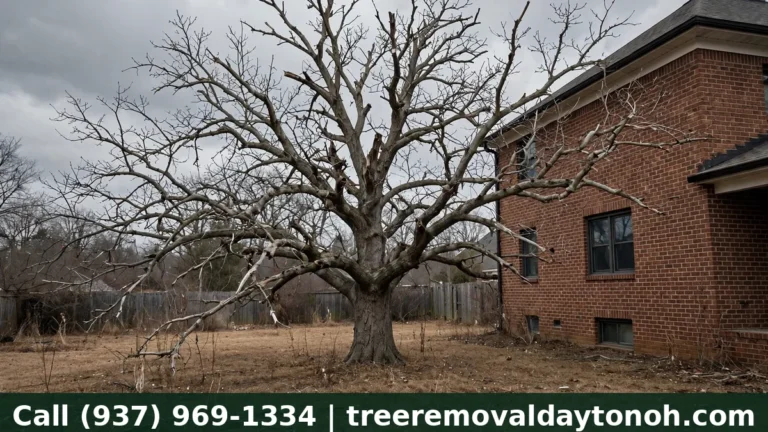
Dayton homeowners usually call for one after a storm twists a canopy out of shape, when mushrooms appear at the base of a mature oak, when a trunk develops a crack or starts to lean, or before building an addition under a large tree. It is also the document insurers, neighbors, and cities ask for when a tree dispute needs facts instead of opinions.
An assessment is not a sales visit for removal. The possible outcomes include monitor on a schedule, prune to reduce weight, install a support cable, treat a correctable problem, or remove the tree when no other option controls the risk. Our hazard tree assessment service page explains the visit step by step.
Worried About a Tree Over Your Home? Call Tree Removal Dayton Ohio at (937) 969-1334
What Does an Arborist Check on the Trunk and Bark?
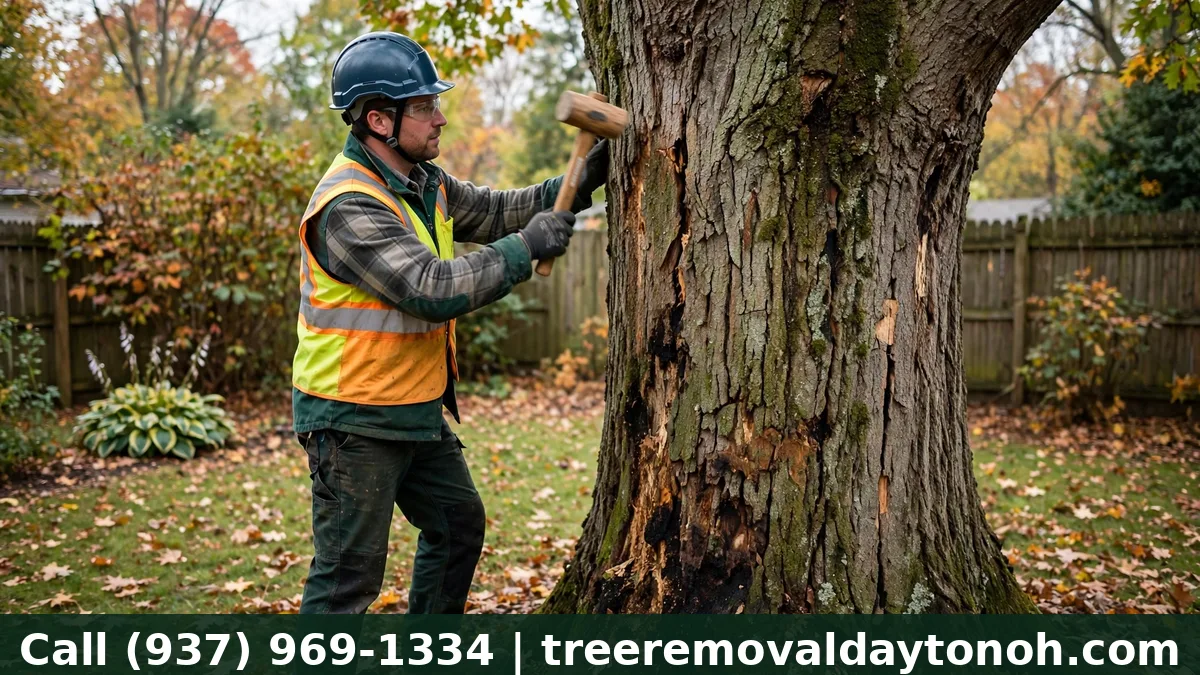
The trunk carries the whole tree, so it gets the closest look. The arborist walks the full circumference, checking for cavities, cracks, seams where two stems press together, sunken or missing bark, and oozing patches that suggest bacterial infection. Each defect is measured and photographed, because a cavity that removes a third of the trunk wall means something very different from one that removes two thirds.
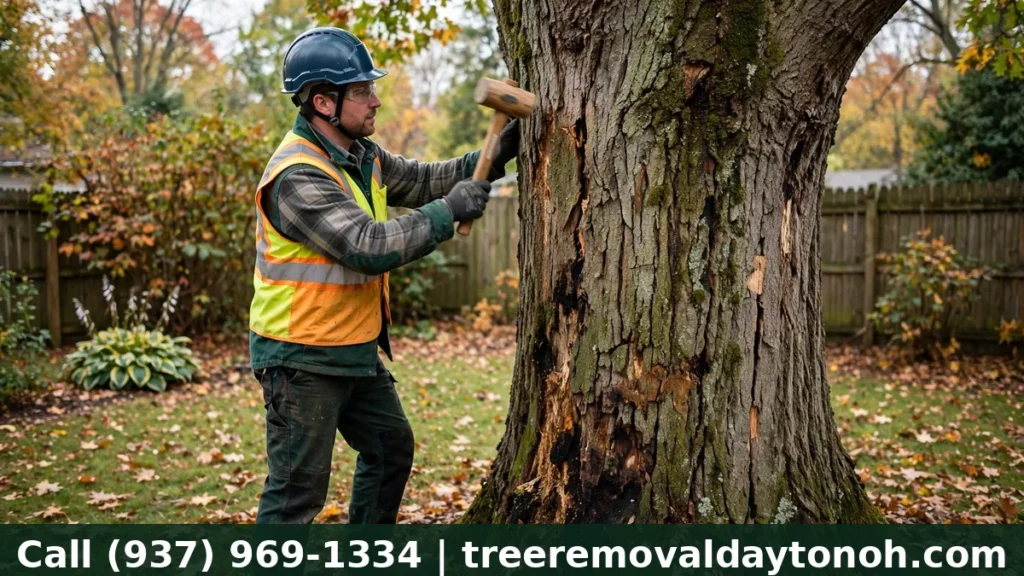
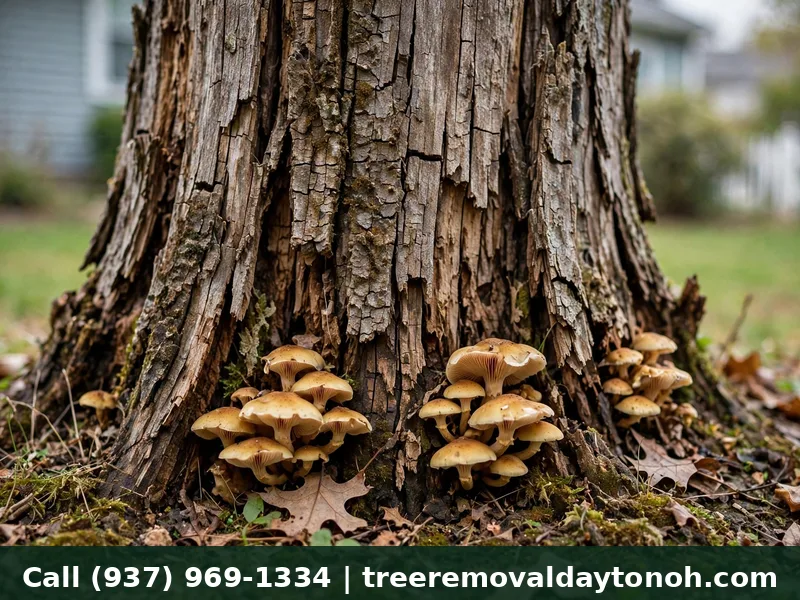
Then comes sounding. Tapping the trunk with a mallet produces a solid ring on sound wood and a hollow thud over decay. Where the sounding suggests hidden rot, the arborist may recommend deeper testing with a probe or a resistance drill that maps exactly how much solid wood remains. Fungal bodies on the trunk, including shelf like conks, are treated as outward signs of the decay columns inside.
Bark condition tells a story as well. Bark sloughing off in sheets, deep vertical cracks, and patches where woodpeckers have worked the same spot for seasons all point to dead or decaying wood underneath. Our guide to dangerous tree signs in Dayton shows what these defects look like so you can spot them between professional visits.
| Part of the Tree | What the Arborist Checks | What It Can Mean |
|---|---|---|
| Roots and soil | Root flare, soil heave, fungal growth, recent digging or grade changes | Root rot or a root plate starting to lift and lose its grip |
| Trunk and bark | Cavities, cracks, seams, conks, oozing, sounding with a mallet | Internal decay and how much sound wood is left |
| Branch unions | Included bark, tight V shaped forks, old pruning wounds | Weak attachments likely to split under wind or ice load |
| Canopy | Deadwood, dieback at the tips, unbalanced or overextended limbs | Limb drop risk and weight pulling the tree off balance |
| Targets below | Roofs, driveways, sidewalks, play areas within falling distance | How serious the consequences of a failure would be |
How Are Roots and Soil Checked Without Digging Up Your Yard?
Most root problems show themselves at the surface. The arborist inspects the root flare where the trunk meets the ground, looking for fungal clusters, soft or spongy wood, cracks in the soil on one side, and soil that has heaved or lifted on the side opposite a lean. A tree that has started to tip often announces it below ground before it moves above ground.
History matters as much as what is visible. Recent trenching for utilities, a new driveway cut, a raised garden bed built against the trunk, or a change in drainage across the yard can each kill roots on one side of a tree. In Dayton clay soils, which hold water and then shrink hard in dry summers, root stress shows up fast in the canopy. The arborist connects those site changes to the symptoms overhead.
When surface signs are not enough, a careful excavation with an air tool can expose roots without cutting them, confirming whether decay or damage is present. That step is only recommended when the answer changes the decision, because a sound root system is the anchor for everything above it.

What Gets Checked in the Canopy?
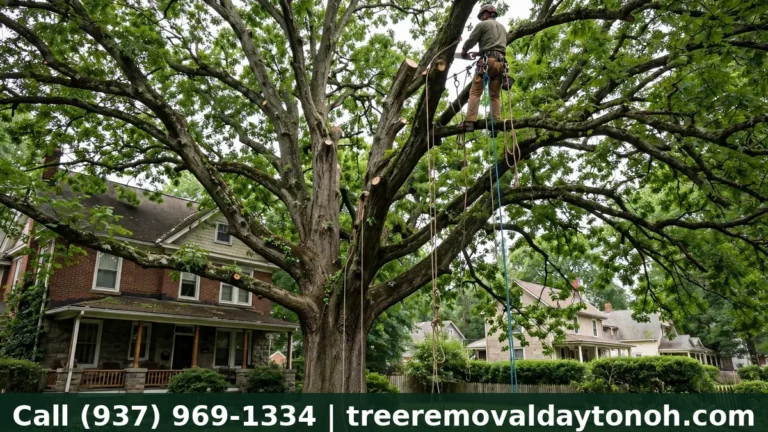
From the ground with binoculars, and from within the tree when the risk justifies climbing, the arborist maps the canopy branch by branch. Deadwood is sized and counted, because a two inch dead twig and a ten inch dead limb over a patio are different problems. Dieback at the outer tips signals root or vascular trouble feeding the whole crown.
Branch structure gets equal attention. Codominant stems with bark trapped in the fork, long overextended limbs reaching for light over a roof, and old topping cuts with weakly attached regrowth are the classic failure points in Dayton silver maples, Bradford pears, and pin oaks. Weight distribution matters too: a canopy that grew lopsided after a neighboring tree was removed now catches wind it never had to handle before.
Book a Hazard Assessment Before the Next Storm, Call (937) 969-1334
How Is the Risk Rated After the Inspection?
Professional risk rating weighs three things together: how likely the tree or a part of it is to fail within a stated period, how likely that failure is to strike a target, and how severe the consequences would be. A hollow tree leaning over an unused woodlot scores low. A moderately decayed tree over a child bedroom scores high, even if the defect is smaller.
This is where a written assessment protects you. If a tree we rated as sound later concerns a neighbor, or an insurer asks why a tree near your home is being removed, the report answers with dated photos and measured findings. When the finding is removal, our Dayton dead tree removal guide explains how timing and condition affect the work, and our tree removal services page covers methods from sectional dismantling to crane lifts.
What Happens After a Hazard Assessment?
You receive the findings in plain language with one of four recommendations. Monitor means the tree is sound enough to keep with a recheck date, usually one to three years or after major storms. Reduce means pruning deadwood and shortening overextended limbs to lower the load. Support means a cable or brace for a valuable tree with a weak union. Remove means the defect cannot be corrected and the target below makes the risk unacceptable.
Each option comes with a written quote where work is needed, and monitoring costs nothing but a calendar reminder. Many Dayton trees we assess stay standing with a pruning plan. The point of the visit is the right answer for that tree, not a predetermined one.
Get a Written Finding for Your Tree, Call (937) 969-1334
Important Considerations
An assessment is a snapshot in time. Decay advances and storms change trees, so a clean report from three years ago does not guarantee a tree today. Recheck after major wind events, after construction near the tree, and whenever new cracks, fungi, leans, or dieback appear.
Tell the arborist about the tree history. Past lightning strikes, old vehicle or mower wounds, previous limb failures, and any trenching or grade change near the trunk all sharpen the inspection. Bring old photos if you have them, because canopy change over time is strong evidence.
Keep the written report with your home records. It supports insurance conversations, documents due diligence if a neighbor dispute ever arises, and helps the next arborist see how the tree has changed since the last visit.
If the assessment finds an immediate hazard, limit access under the tree until the work is done. Park elsewhere, keep children and pets clear, and treat a tree touching a power line as a utility matter first.
Frequently Asked Questions
How much does a hazard tree assessment cost in Dayton Ohio?
Many Dayton area assessments are provided free when the visit leads to a work quote, while a standalone written report for insurance, a property sale, or a neighbor dispute is commonly priced as a modest flat fee based on the number of trees and the depth of reporting. Ask when you book which format you need, so the visit produces the document your situation requires.
Does an assessment always mean the tree must be removed?
No. A large share of assessed trees are kept with monitoring, pruning, or a support cable. Removal is recommended only when decay, structure, or root failure cannot be corrected and something valuable sits within falling distance. A good assessment gives you options with honest urgency levels, not a single take it or leave it answer.
How long does a hazard tree assessment take?
A single yard tree usually takes thirty to sixty minutes, including photos and a walkthrough of the findings. Multiple trees, deep decay testing, or a formal written report for a third party take longer. You receive the verbal findings the same day, and written reports follow within a few business days.
Can an assessment tell if a tree is hollow inside?
Yes, within practical limits. Sounding with a mallet, visible fungal bodies, and cavity measurements estimate how much solid wood remains. When the decision hinges on the exact figure, resistance drilling maps the trunk wall precisely. Arborists then compare the remaining sound wood against the load the tree carries to judge whether it can stand safely.
Should I get an assessment before buying a home in Dayton?
It is a smart move when the property has large mature trees near the house. A pre purchase assessment flags removals or pruning you should budget for, identifies species with known failure patterns in the Miami Valley such as silver maple and Bradford pear, and gives you documentation for your insurer from day one.
Does Tree Removal Dayton Ohio provide written hazard reports?
Yes. We document each tree with photos, measured findings, a risk rating, and a clear recommendation with options and timing. If removal is the answer, we quote it in writing and explain the method that keeps your property safe. Call (937) 969-1334 to schedule an assessment anywhere in the Dayton metro.


8 Comments