

Tree Too Close to House Dayton Ohio: When to Trim, Root Prune, or Remove
TL;DR: Is Your Tree Too Close to Your House?
- A tree is too close to your house when its branches touch the roof or gutters, or its roots are lifting concrete, cracking the foundation, or invading sewer lines.
- As a rule of thumb, a tree should stand at least as far from the house as its mature canopy spread. Most large shade trees in Dayton need 25 to 40 feet of clearance.
- Ohio’s clay soil makes root problems worse: roots travel shallow and wide looking for moisture, and they will exploit any foundation crack or sewer joint.
- Small problems get fixed with pruning and root barriers. Structural root damage or a tree leaning over the house usually means removal.
- Not sure which it is? Call Tree Removal Dayton Ohio at (937) 969-1334 for an honest on-site assessment anywhere in the Dayton area.
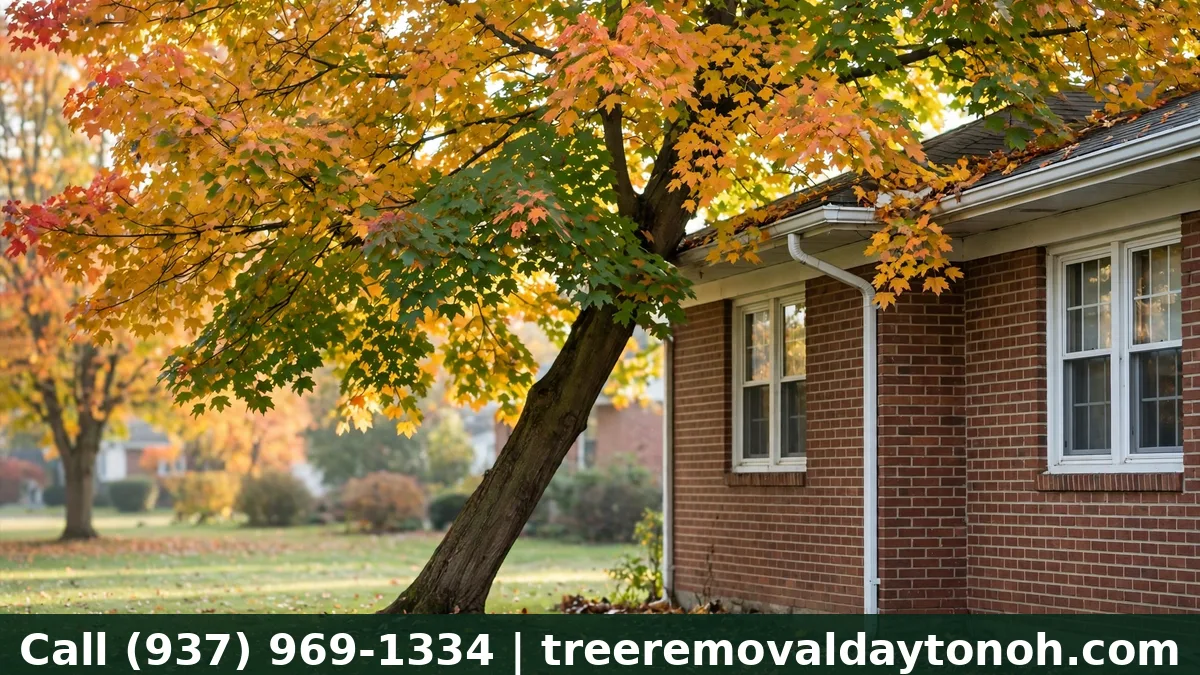
Drive through any older Dayton neighborhood and you will see it: a silver maple planted twenty feet from the foundation decades ago that now dwarfs the house, or a pin oak whose branches scrape the gutters every time the wind picks up. The tree was small when someone planted it. It is not small anymore, and now you are wondering whether it is too close.
This guide covers exactly how to tell, what the real risks are for Dayton-area homes, and what your options look like, from pruning and root barriers all the way to full removal.
Tree crowding your home? Call (937) 969-1334. Tree Removal Dayton Ohio will assess it in person and tell you the truth about whether it can stay.
How Close Is Too Close?
The simplest test is the mature canopy rule: a tree should sit at least as far from your house as the widest spread of its mature canopy. For a large shade tree like a silver maple, sycamore, or pin oak, that means roughly 30 to 40 feet of clearance. Medium trees like flowering crabapples or dogwoods need 15 to 20 feet. Small ornamentals can sit 8 to 10 feet away.
Roots spread even wider than branches, typically one and a half to two times the canopy radius. So a tree that looks like it is a safe distance away based on the trunk alone can still send roots under your foundation or into your sewer lateral.
Here are the warning signs that the distance is already a problem:
- Branches touching or overhanging the roof, gutters, or siding
- Roots lifting or cracking sidewalks, driveways, patios, or the foundation
- Foundation cracks near the side of the house closest to the tree
- Gutters filling with leaves and twigs faster than you can clean them
- Moss, algae, or mildew growing on the siding where the tree blocks sun and airflow
- Recurring sewer backups traced to root intrusion
If you see any of the structural items on this list, it is worth reading our guide to dangerous tree warning signs next, since root-damaged trees can also become unstable.
Root Damage: The Slow, Expensive Problem
Canopy problems are obvious. Root problems are not, and that is what makes them expensive. In the Dayton area, many homes sit on clay-heavy soil. Clay holds water but compacts easily, so tree roots stay shallow and spread wide, often just 6 to 18 inches below the surface. That is exactly the zone where your foundation footings, sewer lateral, and water lines live.
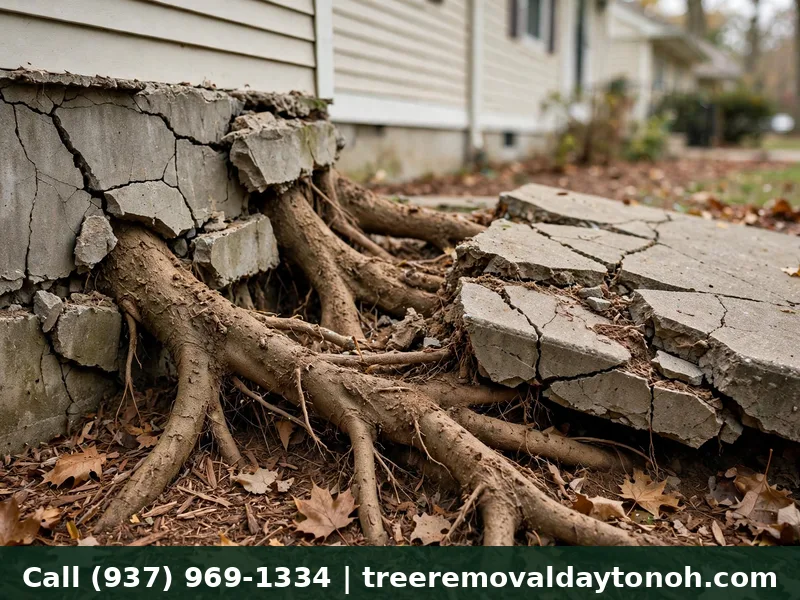
Roots do not smash through solid concrete. What they do is find the tiniest existing crack, hairline joint, or mortar gap and exploit it, growing into the opening and widening it over years. The classic victims:
- Foundation walls: roots press against walls and wedge into cracks, letting water follow the root path inside. Look for horizontal cracking or inward bowing on the wall nearest the tree.
- Sewer laterals: clay and concrete sewer pipes in older Dayton neighborhoods have joints that roots infiltrate in search of water. The result is recurring backups that snaking only temporarily clears.
- Sidewalks and driveways: shallow roots lift slabs, creating trip hazards you may be liable for if they are on a public sidewalk.
- Basement moisture: root channels become water channels during heavy rain, routing water toward instead of away from the foundation.
Noticing foundation cracks or backups near a big tree? Call (937) 969-1334 for a professional assessment before the damage compounds.
Canopy Damage: Roof, Gutters, and Siding
Branches rubbing a roof act like slow sandpaper. Over seasons of wind, bark grinds away asphalt shingle granules, shortens the roof’s life, and creates entry points for water. Leaves and seed pods pile in gutters, which then overflow during storms and dump water next to the foundation, which feeds right back into the root problem above.
Shade is the quieter issue. A canopy parked over the north side of a house keeps siding damp year round in Ohio’s humid summers. That invites moss, mildew, and wood rot on fascia and trim, and it can trap moisture against masonry.
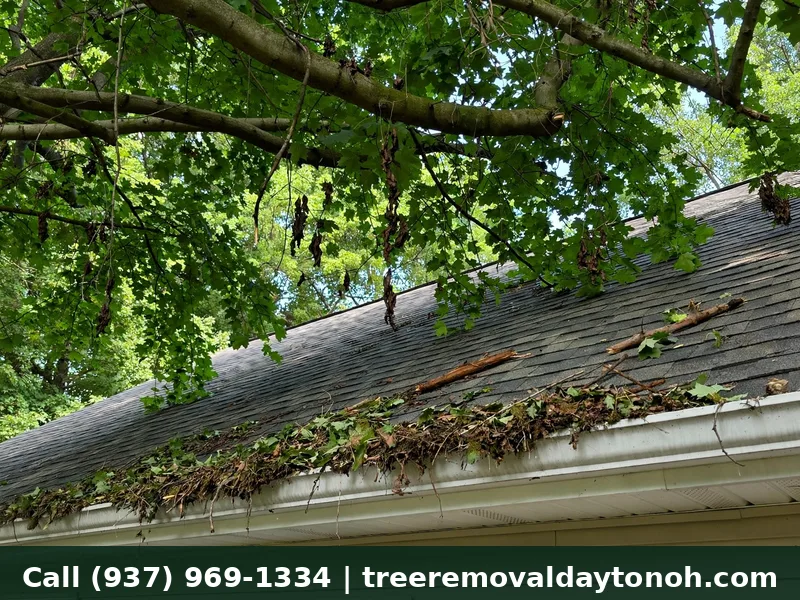
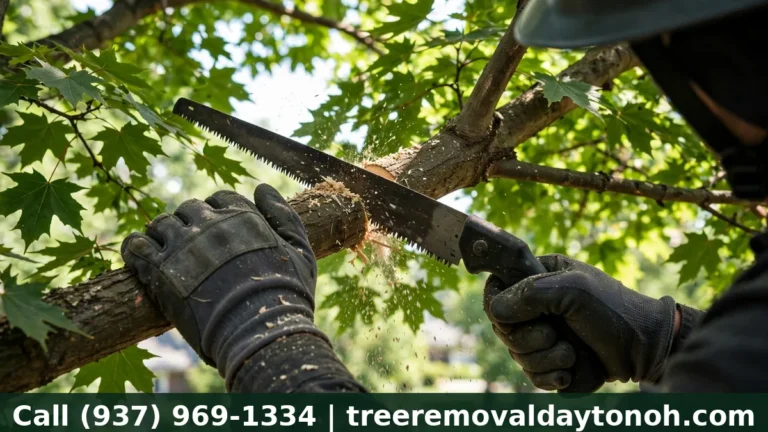
Pruning can solve canopy problems without removing the tree. A proper crown reduction or structural pruning by an experienced crew restores clearance while keeping the tree healthy. What you should not do is top the tree, which is one of the fastest ways to ruin a shade tree. If you are unsure about that term, our guide on when to trim trees in Ohio covers safe pruning practices and timing.
Trim, Root Barrier, or Remove? Compare Your Options
| Option | Best for | Typical cost context | Limitations |
|---|---|---|---|
| Canopy pruning | Branches touching the roof or gutters, tree otherwise healthy | Lower; see our tree trimming cost guide | Does nothing about root problems |
| Root pruning plus root barrier | Young roots threatening a walkway or a specific slab, tree otherwise sound | Moderate | Can destabilize mature trees if more than about 25 percent of roots are cut |
| Partial removal (limbs only) | One hazardous limb or co-dominant stem over the house | Moderate | Buy time, not a permanent fix for foundation-level issues |
| Full removal plus stump grinding | Roots damaging foundation or sewer, tree leaning toward house, trunk inside the drop zone | Higher; see tree removal cost in Dayton | The tree is gone; replant farther away |
Removing a tree that sits too close usually involves tight quarters, so it pays to know what that job looks like. Our guide on how long tree removal takes covers the timeline for difficult-access jobs.
Weighing your options? Call (937) 969-1334. We will tell you honestly whether pruning will do or removal is the smart call.
Important Considerations Before You Decide
- Ohio clay soil magnifies everything. Shallow, wide root systems in clay mean a tree 20 feet from the house can still affect the foundation. Distance rules that work in sandy soil underestimate the risk here.
- Silver maples and sycamores are the repeat offenders. These fast growers are among the most common trees in Dayton yards and the most likely to cause root and canopy conflicts close to homes.
- Do not cut structural roots yourself. Severing roots larger than about 2 inches on a mature tree can destabilize it or send it into decline. One bad root cut can turn a healthy tree into a hazard.
- Check your sewer lateral age. If your home still has clay or concrete tile sewer pipe and a big tree within 30 feet, schedule a camera inspection. Root intrusion shows up long before backups do.
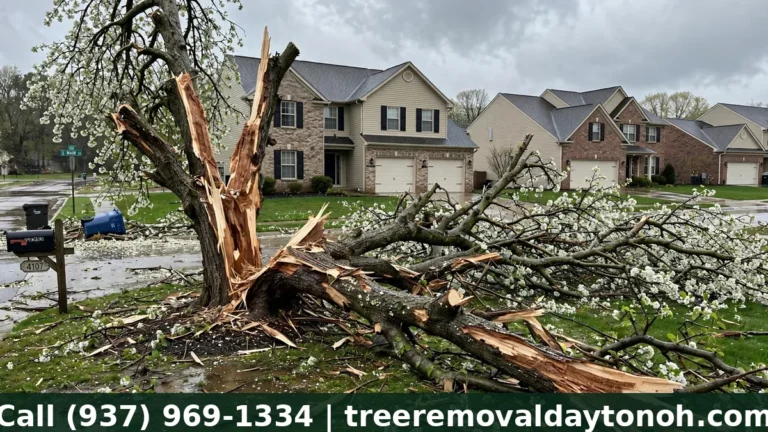
- Insurance rarely covers gradual damage. A tree falling on your house in a storm is a covered event. Slow foundation damage from roots over a decade is usually not. Fixing it early is cheaper than fighting a claim later.
- Replant smarter, not farther in panic. If the tree comes down, replant at proper mature spacing. A 40-foot tree needs a 40-foot berth, and planting depth and species matter as much as distance.
FAQs: Trees Too Close to Houses in Dayton
How far should a tree be from a house in Ohio?
Match the distance to the mature canopy spread: 30 to 40 feet for large shade trees, 15 to 20 feet for medium trees, and 8 to 10 feet for small ornamentals. In clay soil, add margin for wide root spread.
Can tree roots really damage a foundation?
Yes, indirectly. Roots exploit existing cracks and joints, widening them over years and channeling water toward the foundation. They also dehydrate clay soil in dry spells, causing uneven settling. In severe cases we see walls pushed inward on the tree side.
Will cutting the roots kill the tree?
It can. Removing more than about a quarter of a tree’s roots, or cutting large structural roots near the trunk, often destabilizes or slowly kills a mature tree. That is why root work near structures should be planned by an experienced arborist, not done with a chainsaw on a Saturday.
Does homeowners insurance cover tree root damage to a foundation?
Usually not. Gradual root damage is considered maintenance, not a sudden covered event. A tree that falls and damages the house in a storm is a different situation. See our guide on insurance claims for storm-damaged tree removal for what is typically covered.
Should I just trim the branches and leave the tree?
If the problem is purely canopy-related, pruning is often the right answer and costs far less than removal. If roots are damaging concrete, foundation, or sewer lines, pruning fixes nothing and the tree likely needs to come out.
Who removes a tree that is too close to a house in Dayton?
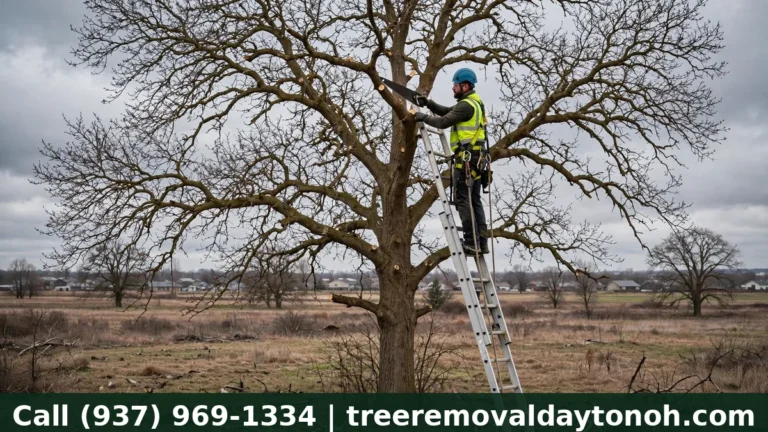
Call a professional tree service with experience in tight-access removals. Tree Removal Dayton Ohio handles crane-assisted and rigged removals where there is no room to fell a tree. Call (937) 969-1334 for a free on-site assessment.
Still unsure how close is too close? Call (937) 969-1334 today. We will walk your property with you, show you exactly what the tree is doing to your house, and lay out your options, from pruning to full removal with stump grinding.
2 Comments